



Gene scientists debate ethics of experiment









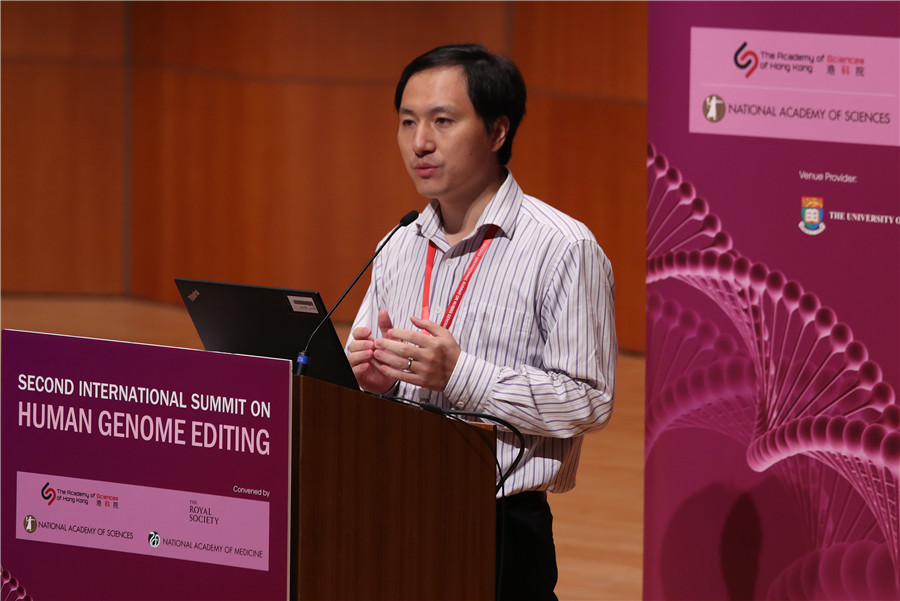
Chinese researcher's alteration of human cells widely condemned
The National Health Commission and the Ministry of Science and Technology issued a statement on Wednesday saying they are paying a lot of attention to the case of two gene-edited babies-a matter that ignited concerns worldwide about ethical research.
"We always attach importance to safeguarding people's health rights and interests. Conducting scientific research and medical activities should abide by related laws, regulations and ethic rules. We will always punish any illegal activity," the statement said. The ministries are continuing to investigate.
He Jiankui, the Chinese researcher who found himself in the global spotlight over his genetic manipulation of human cells, triggered a global ethical storm on Monday after he claimed to have genetically altered a pair of twins, Lulu and Nana, in an attempt to make them immune from HIV.
He recruited eight couples through an AIDS support group. One couple dropped out, and He got about 30 eggs from the seven remaining couples.
Attending the Second International Summit on Human Genome Editing in Hong Kong on Wednesday-where he had already been scheduled as a speaker-He was asked by a participant about his decision to go ahead with human trials.
He said he was "proud" of his work, and believed that he was helping people who otherwise would have no hope for life. The twins were born healthy this month in China, He said.
World-leading researchers at the summit who heard his account expressed deep concerns about the ethical risks and unpredictable possible outcomes of the experiment.
David Baltimore, chair of the summit's organizing committee, said it would be irresponsible to proceed with any genome editing at the clinical level unless and until the safety issues have been dealt with and there is universal consensus.
Baltimore said He's research was not transparent and shows a failure of self-regulation by the scientific community.
Robin Lovell-Badge, head of the Laboratory of Stem Cell Biology and Developmental Genetics at the Francis Crick Institute in the UK, said He was misguided and took bad advice.
In the talk, He said he had approached four other scientists in China and the United States to review the consent form he later gave to the parents. He said he also received feedback from scientists at meetings over the past few years.
Part of the reason he went ahead, He said, was his observation of earlier public survey and study results in the United States and the United Kingdom indicating a majority in society seemed to find the idea acceptable.
Lovell-Badge said He failed to do research in a properly controlled and careful manner, including publishing findings along the way and involving authorities in making decisions whether to go further.
The process of obtaining patients' informed consent was poorly executed, Lovell-Badge said.
Wei Wensheng, a professor at Peking University, asked He why he chose to cross a red line by performing clinical trials in secret.
That red line-the international consensus on prohibiting genome editing on germlines, which can pass on their genetic material to offspring-h(huán)as been observed by the Chinese science community since the first human genome editing summit in 2015.
In response, He said he had consulted several institutions for feedback.
Many technical questions were raised about the necessity and authenticity of He's experiment.
David Liu from Harvard University questioned He on the unmet medical need of the experiment. Liu said an HIV-positive father and an HIV-negative mother already have a high possibility of having an HIV-free baby after "sperm washing", an effective technique that separates sperm from infected cells before fertilization to ensure the virus isn't transmitted. During the talk, He said he had performed the procedure in the experiment.
Some scientists also voiced concerns over the backlash of He's experiment on gene editing technologies worldwide.
"I feel more disturbed now," said Liu, who is also associated with MIT's Broad Institute and is the inventor of a variation of the gene editing tool. "It's an appalling example of what not to do about a promising technology that has great potential to benefit society. I hope it never happens again," he was quoted as saying by the Associated Press on Wednesday.
George Daley, dean of Harvard Medical School and one of the conference organizers, said that because the case might have been a misstep, it "should in no way, I think, lead us to stick our heads in the sand and not consider the very, very positive aspects that could come forth by a more responsible pathway".
Still, Daley added, "Scientists who go rogue... it carries a deep, deep cost to the scientific community".






- IP protection for new fields to improve
- Draft rules define premade dishes in consumer interest
- Self-powering pacemaker could last a lifetime
- China intensifies crackdown on misuse of personal data
- China issues new rules classifying online content harmful to minors
- Chinese vice-premier urges efforts to consolidate poverty alleviation achievements














