



China and Canada eye more mutually beneficial trade deal









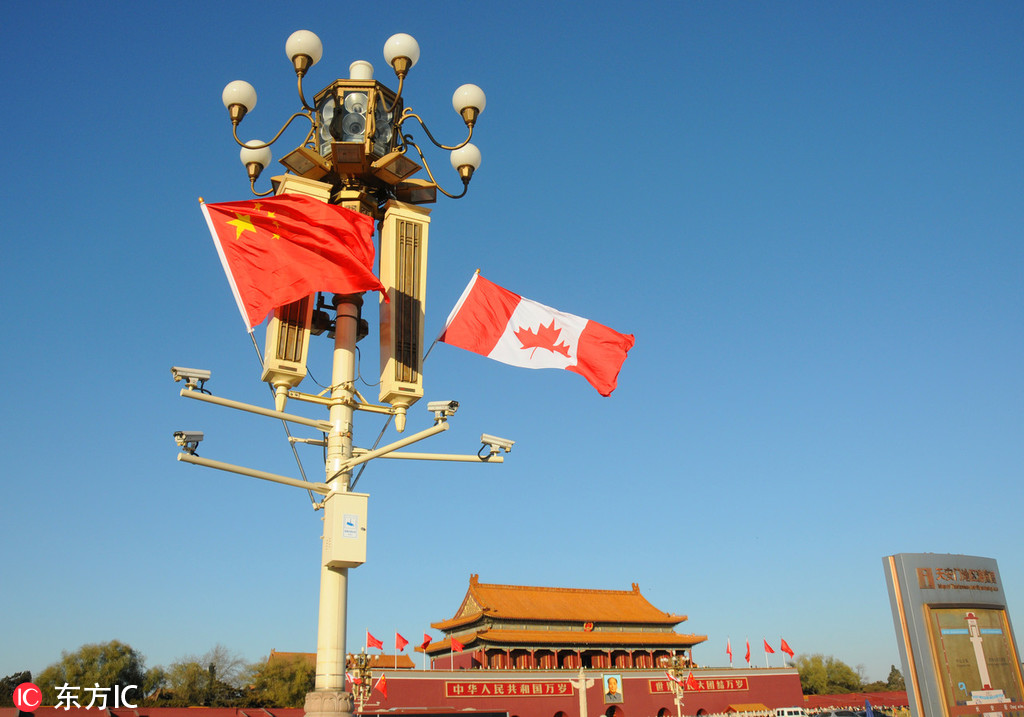
A clause in the US-Mexico-Canada trade pact, widely known as a "poison pill" aimed at China, will not stop Canada from continuing to negotiate a free trade agreement with China, Canadian Prime Minister Justin Trudeau said at an event at the National University of Singapore on Thursday. This suggests the US will find it extremely difficult to administer its "poison pill", because it has gone too far in using bullying tactics against other countries-in this case, China.
It is nearly impossible for the US to win over the international community's support for bullying other countries, although some countries have been forced to succumb to the superpower's threats.
The "poison pill" refers to Article 32.10 in the USMCA trade pact, which requires the three North American countries to inform each other of their intention to start free trade agreement negotiations with a "nonmarket economy" at least three months in advance, while the parties are free to terminate the USMCA trade deal on a six-month notice and replace it with a bilateral agreement.
In addition, the country negotiating an FTA with a "nonmarket economy" has to provide as much information as possible regarding the objectives of the negotiations upon request, and the opportunity to review the full text of the agreement at least 30 days before signing it.
To begin with, there is no international standard to define a "nonmarket economy", which means its description would be subject to the interpretation of the domestic law of the members of the USMCA deal. The US' Tariff Act of 1930 sets forth six rules for revoking the status of a nonmarket economy, including the extent to which the economy's currency is convertible into the currencies of other countries and the extent of government control over the allocation of resources and the price and output decisions of enterprises.
This is the basis on which the US Commerce Department listed China as a nonmarket economy in 2017. And it devised the "poison pill" clause with the goal of forcing Canada and Mexico to choose between the US and China in forging FTAs. This shows the US' strategy is to prevent the advancement of bilateral FTAs between countries such as Mexico and Canada and China, and disrupt China's goal of building an FTA network.
The USMCA trade deal, which replaces the North America Free Trade Agreement, is essentially a new set of high-standard trade rules. Compared with the Trans-Pacific Partnership agreement, the USMCA trade pact boasts higher standards and offers more practical ways of implementation.
The efforts Canada has made to neutralize the effects of the "poison pill" show both Beijing and Washington are important to Ottawa. If Canada has yielded to US pressure and accepted the "poison pill" clause in the trade pact, it has also strived to push negotiations with China forward. Apart from Canada, economies such as Japan, the Republic of Korea and the European Union all hold similar views on the new trade talks, and are reluctant to accept it. So the US, in the end, may not be able to win the approval of even many of its close trade partners for its bullying tactics.
The solid trade foundation and huge cooperative potential between China and Canada are conducive to an FTA, especially because their bilateral trade in 2017 increased 13.3 percent year-on-year to reach $51.76 billion. China is the second-largest trade partner of Canada-after the US-so it is understandable that Ottawa is eager to promote FTA negotiations with Beijing despite the USMCA's trade terms. Besides, from a strategic point of view, Canada can largely reduce its over-reliance on the US by reaching trade deals with China, and other countries.
In the near future, China-Canada trade cooperation is expected to offset the effects of the US' "poison pill" and forge a stronger and mutually more beneficial trade relationship. Even though differences on issues such as labor, the environment and gender equality hindered the two sides from finalizing the agreement last year, as widely hoped, Prime Minister Trudeau's recent statement has raised hopes that it could be finalized and inked soon.
A day after signing the trade deal, Trudeau not only said that the USMCA trade pact won't stop Canada from negotiating an FTA with China, but also clarified that the "poison pill" clause will not prevent Canada from doing anything it is already doing in its trade negotiations with China in his speech on Thursday. Canada's firm stance on carrying the China-Canada FTA negotiations forward deals a blow to the US and its unilateral and protectionist policies, and augurs well for a China-Canada FTA.
Dong Yan is director of the International Trade Office at the Institute of World Economics and Politics of the Chinese Academy of Social Sciences, and Bai Jie is a post-doctoral at the same institute.





