


Category of site: Cultural Site
Brief introduction
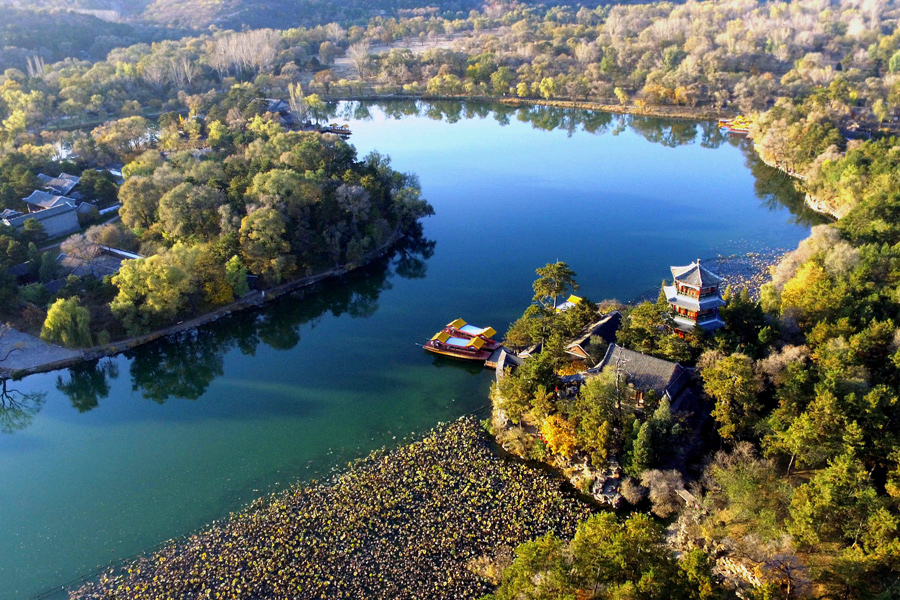
In terms of the general layout, architectural styles, construction techniques, decoration details and garden landscape, the Mountain Resort, a vast complex of palaces and administrative and ceremonial buildings built between 1703 and 1792, represents the broad exchange and convergence between Han culture and the ethnic cultures - Confucianism, Buddhism and Taoism - and the architectural styles between China's north and south. Covering a total area of 611.2 hectares, the Mountain Resort has temples of many architectural styles and imperial gardens blend effortlessly into a landscape of lakes, pastureland and forests. Apart from its aesthetic interest, the Mountain Resort is a rare historic vestige of the final development of feudal society in China.
The Mountain Resort was added to the list on December 15, 1994.
History
Since it is only 250 kilometers from Beijing, emperors of the Qing Dynasty lived here with their concubines and ministers in the summer months every year. The emperors handled court affairs and received foreign envoys and tribal leaders in this summer resort, which was known as the second capital of the Dynasty. The structures of the resort mainly include the Detachment and Loyalty Hall, which is entirely made of valuable nanmu wood, and Wenjin Tower, a library housing the Complete Chinese Classics. In addition, there are also Golden Mountain Temple and Good Luck Islet.
Some constructed in the architectural styles of the ethnic minorities, the 12 outlying imperial temples are distributed across the eastern and northern hills outside the palace and garden area, fostering relations with the ethnic minorities and helping to safeguard the Mountain Resort. The existing temples include Puning Temple, Pule Temple, Xumifushou Temple, Putuozongsheng Temple, Anyuan Temple and Shuxiang Temple.
Emperors of the Qing Dynasty including Kangxi and Qianlong dealed with military and government affairs of the country and received leaders of ethnic minority groups and diplomatic envoys from foreign countries here every summer and autumn. They also went north to hold the Mulan Autumn Hunting. Since here held many important historical events of the Qing Dynasty, the historical sites and objects have witnessed the consolidation and development of China as a unitary multi-ethnic state.
Significance
The Mountain Resort and its Outlying Temples, Chengde represents great achievements of Chinese palace architecture, gardening art and religious architecture. The design of the landscape of the Mountain Resort has followed the topography of natural hills and water. As an exceptional example of Chinese natural landscape gardens and palaces, it inherits and carries forward China's imperial gardening tradition. Through the integration of elements of Han, Mongolian and Tibetan architectural art and culture, the Outlying Temples crystallize the achievements of cultural exchanges and integration among different ethnic groups in the history of Chinese architecture.
Cultural heritage
Wenjin Tower was built in 1774 to store the Complete Chinese Classics. It has three stories and the middle one is sheltered from sunshine.
Under the ancient pine tree to the east of the tower, there stands a tablet with Emperor Qianlong's calligraphy on it. A total of seven copies of the grand works were made during the reign of Qianlong. The copy stored in Wenjin Tower was moved to Beijing in 1915. It was later stored in the Capital Library and is now in the collection of the National Library of China.
Mountain Resort and its outlying temples, Chengde is a vast complex of palaces and administrative and ceremonial buildings. Temples are built of various architectural styles and imperial gardens blend effortlessly into a landscape of lakes, pastureland and forests. Apart from its aesthetic interest, it is a rare historic vestige of the final development of feudal society in China.
Eight temples in the exterior
There are only seven left of the Exterior Eight Temples, namely, Puren Temple, Puning Temple, Pule Temple, Xumi Fushou Temple, Putuo Zongcheng Temple, Anyuan Temple and Shuxiang Temple. The construction of these temples contributed much to the unity among China's various minority ethnic groups, the consolidation of the empire's rule and defense against foreign invasion.
Legends and stories
There is a miraculous folk tale about this imperial summer resort, the largest one of its kind in China. It is said that once Emperor Kangxi led a group of officials and generals hunting. In pursuit of a mysterious white rabbit, the emperor discovered a hot spring, beyond which was a vast grassland backed by tree-shrouded mountains. He immediately decided to build a palace there. As soon as he had announced his intention, the white rabbit appeared before him again. The emperor realized that the rabbit had been divinely sent to guide him to the spot.





