



Mike Pence needs a history lesson on the Korean War









Note: This is a translation of a Chinese-language article first published by Xinhuanet.com. The article reflects the author’s own views.
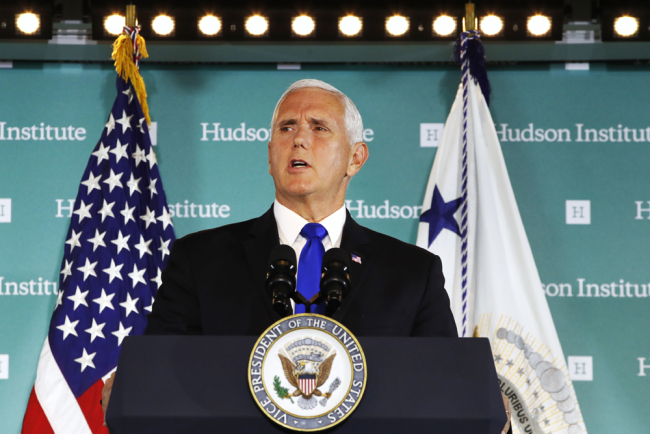
In his speech on U.S. government policy towards China at the Hudson Institute in Washington D.C. on October 4th, 2018, U.S. Vice President Mike Pence stated the Communist Party of China (CPC) began to pursue “authoritarian expansionism” after taking power in 1949. He said it was “remarkable” to think that China and the U.S. fought one another in the mountains and valleys of the Korean Peninsula only five years after they had fought together, and that his father saw combat on that “frontier of freedom.” Such remarks fly in the face of historical fact.
First of all, the Korean War broke out in 1950, not long after the People’s Republic of China was founded, at a time when the CPC’s top priority was to realize the country’s reunification. The Kuomintang had fled to Taiwan after losing a civil war with the CPC, and the People’s Liberation Army was preparing in southeast China’s coastal area for the liberation of Taiwan. There was then absolutely no way that the CPC would be seeking expansionism. The Korean War was a product of the Cold War, with the Korean Peninsula split into two states. The U.S. played a key role in the decision to divide the Korean Peninsula at the 38th parallel. Before the war broke out, both Kim Il Sung, the then-top leader of the Democratic People’s Republic of Korea (DPRK), and Rhee Syng-man, the South Korean President at the time, proposed that the Korean Peninsula should be reunified by force. Rhee’s voice was the louder. Declassified documents from the Soviet Union show that in January 1950, Joseph Stalin, then-leader of the Soviet Union, invited Kim to discuss the reunification of the Korean Peninsula in Moscow. During his month-long visit to Moscow from March 30th to April 25th, 1950, Kim met with Stalin for three times. There’s no record giving the details of their talks, but later actions proved that Stalin supported Kim’s ambition to reunify the Korean Peninsula.
Secondly, China eventually joined in the Korean War because U.S. actions were threatening China’s own national security, and that of the Chinese people, and so China was forced to take action to protect homes and safeguard the country. The security of the DPRK has always been closely bound up with China’s national security and its own interests. In the belief that the Korean War was the first phase in a Soviet Union plan to launch a global war, the U.S. got involved in the conflict not long after it broke out. On June 27th, 1950, then-U.S. President Harry Truman ordered the country’s naval, air and other military forces to fight with South Korean troops. On July 27th, a United Nations force led by the U.S. landed in Pusan, while at the same time, the U.S. sent its Seventh Fleet into the Taiwan Straits to frustrate China’s reunification. At an event celebrating the National Day held by the Chinese People’s Political Consultative Conference National Committee on September 30th, 1950, then-Chinese Premier Zhou Enlai gave a solemn warning to the U.S. that while the Chinese people loved peace, in order to safeguard that peace, they have never been and would never be afraid to oppose war, and that the Chinese people would never tolerate foreign aggression, nor tolerate seeing their neighbors being savagely invaded by imperialists. On October 3rd, 1950, Premier Zhou Enlai once again warned the U.S. via the Indian Ambassador to China, that China would take action instead of sitting idle, if the U.S. forces should cross the 38th parallel, and that the Korean issue should be settled peacefully. He said the war must be stopped, and the invaders must retreat. However, the U.S. government underestimated China’s resolution and determination, and Douglas MacArthur issued an order to cross the 38th parallel and launch military attacks at a time when the Chinese people were celebrating the first anniversary of their new republic. The flames of war burned even at China’s own gates, with parts of Chinese territory along the China-DPRK border bombarded by U.S. troops. After 18 days of deliberation, China, which was still rebuilding, eventually decided to send troops, and become involved in a war.
Thirdly, the U.S. was in no way fighting to defend freedom, but for geopolitical expansion. The Korean War was originally solely an internal Korean Peninsula matter, where the north and the south were fighting for national reunification. It was the U.S. which regarded it as the expansion of communism and began interfering, enlarging the regional war into an international one, leading to severe casualties. South Korean administrations supported by the U.S. were hardly democratic. During a demonstration launched by South Korean students and other citizens who called for democracy and freedom from May 18th to 27th, 1980, the then-South Korean President Chun Doo Hwan, with the tacit approval of the U.S., deployed troops to Gwangju and opened fire at demonstrators. Official figures suggest 207 people lost their lives and more than 800 others were injured.
In his book Modern Times: The World from the Twenties to the Nineties, British academic Paul Johnson described the Korean War as “a characteristic 20th-century tragedy,” “it achieved no purpose, all its consequences were unintended,” ”Truman judged it to be a prelude to an attack on Japan and a direct challenge to America’s willingness to uphold international law through the UN.” The Korean War resulted from the development of the global situation. It was a war imposed on China by external forces. It was U.S. troops who threatened China’s national security at China’s own gates, forcing China to send forces to defend itself. It is simply ridiculous for Pence to claim that the Korean War was caused by what he called China’s pursuit of “authoritarian expansionism” and that the U.S. was fighting on the so-called “frontier of freedom.”





