



When it comes to Taiwan, America should reflect on its own history









Note: This is a translation of a Chinese-language article first published by Xinhuanet.com. The article reflects the author's own views.
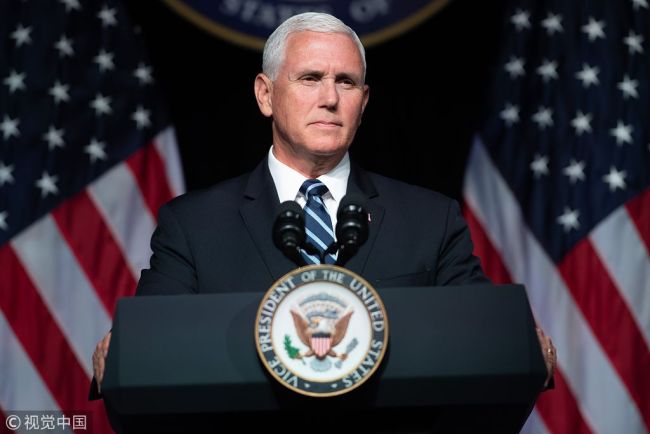
Speaking recently about the Trump administration’s policy toward China, United States Vice President Mike Pence accused China of pressuring three Latin American nations to sever ties with Taipei and to recognize Beijing. He condemned these alleged actions, which he said “threaten the stability of the Taiwan Strait.” His claim reveals his ignorance of history.
Put simply, there is only one China, and Taiwan is an integral part of China’s territory. This has been widely accepted since October 1971, when the United Nations General Assembly passed Resolution 2758, which recognized the government of the People’s Republic of China as the only legitimate representative of China at the United Nations and established the One-China Principle.
This year El Salvador became the 177th country to adopt Resolution 2758 when President Salvador Sánchez Cerén recognized that the government of the People’s Republic of China is the only legitimate representative of China, and that Taiwan is an integral part of China’s territory.
Decades ago, when the United States established formal ties with China, they recognized the One-China Principle. The three joint communiqués that established formal China-U.S. relations, namely the Shanghai Communiqué, the Joint Communiqué on the Establishment of Diplomatic Relations and the August 17 Communiqué, all affirmed the One-China Principle. American adherence to the three joint communiqués and the One-China Principle, and its cooperation with China on restraining Taiwan independence forces, are part of the political foundations of healthy China-U.S. relations.
From time to time, some voices in the United States call on the government there to abandon the promises it made all those years ago. And some go so far as to call for the government to interfere in China’s domestic affairs in relation to Taiwan. Mike Pence, an avowed Christian, would be well aware of the Bible’s admonishment: Do to others as you would have them do to you.
And as a student of history, he would be well versed in his country’s own struggle against separatism.
Abraham Lincoln is held up as one of America’s greatest presidents precisely because he stood firmly against the Southern separatists to safeguard the union. “A house divided against itself cannot stand,” he said in his 1858 speech. “I do not expect the Union to be dissolved - I do not expect the house to fall - but I do expect it will cease to be divided.” In 1861, the country was plunged into a bloody conflict that would leave more than 600,000 dead on battlefields across the countryside. China’s desire to safeguard its unity is just as strong as that of America. Americans fought their deadliest war for the sake of unity; why would they hold China to a different standard when it defends its own territorial integrity?
On October 8 during a meeting with U.S. Secretary of State Mike Pompeo, China’s Minister of Foreign Affairs Wang Yi proposed a series of concrete actions to safeguard China-U.S. relations and stability of the Taiwan Strait. This includes cessation of U.S. official and military contact with Taiwan, and end to arms sales to Taiwan, an end to unreasonable intervention in countries that have established or are hoping to establish relations with China, and restraint on voices calling for Taiwan’s independence.
Any sovereign country that chooses to establish diplomatic ties with China in accordance with United Nations Resolution 2758 should be free to do so without threats or intimidation from the United States. In recent years, the Democratic Republic of S?o Tomé and Príncipe, the Republic of Panama, the Dominican Republic, and Burkina Faso have joined the Republic of El Salvador in establishing diplomatic relations with China. It is their right to do so and Washington should respect their exercise of sovereignty.





