



Astronauts still have the edge over machines









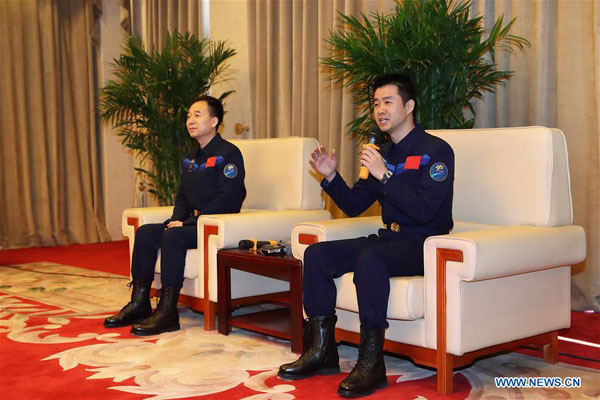
Chen Dong, astronaut aboard the Shenzhou XI mission to Tiangong II in October 2016.
Tiangong II has been in orbit for more than two years, and my 33-day voyage in space was the longest mission to date for Chinese astronauts.
The country spent a tremendous amount of manpower and resources to get us there, and as astronauts, we wasted no time in space.
China has conducted six manned space missions. They have not been frequent or lengthy, so we must accumulate as much data and experience as possible during each one.
We conducted 38 experiments in space. This proves that astronauts are still very important and valuable for space missions, despite much of the space equipment being highly mechanized and automated.
Of the 38 experiments, eight were related to human health, and I believe they are very important experiments for future astronauts to become comfortable in space and complete their tasks efficiently.
For example, eyesight weakens the longer we spend in space. Astronauts also live amid constant noise from within the spacecraft's cabin. This affects our hearing, sleep and mental health.
"Manned" is the key word for a space mission, so any experiments related to protecting human health in space will be crucial.
In space, we act as the eyes and arms of scientists on Earth. We had to manually operate mechanical arms to do repairs in space; we also planted seeds, watered plants, fertilized crops and took daily records of the plants' growth for bio-experiments.
We brought back nine green and healthy lettuce from space. I am proud to say that we fulfilled the space dream of researchers on the ground.
We also conducted numerous science popularization activities in space for children and teenagers. For example, children from Hong Kong designed an experiment about breeding silkworms in space. We carried out the experiment for them and used the opportunity to teach science to middle school children. They loved it.
Some people say that robots might eventually replace astronauts in space, but I want to stress that nobody should underestimate the human capacity. For future space station missions, the systems used will be extremely complicated and malfunctions will be inevitable.
Therefore, human astronauts must be flexible and make quick decisions, as was the case during our repairs in orbit. In terms of dealing with emergencies and adjusting to changing circumstances, humans still have an edge over machines.


- Seven dead, 12 hurt as vehicle rolls over in Yunnan
- Purple sea of?catnip flowers?blooms in Shandong town
- 'Blue tears' turn Fuzhou's beaches fluorescent
- China-made marine-derived antitumor drug to begin combination therapy trials soon
- Wild apple trees create a poetic spring landscape in Xinjiang
- Tianjin town plays leading role in global instrument trade





