"Whoever wants to know something about me," Austrian painter Gustav Klimt once said, "ought to look carefully at my pictures and try to see in them what I am and what I want to do." And what a lot that was. Klimt lived in a late 19th-and early-20th-century Vienna that was intensely bohemian, awash with wild decadence and artistic experimentation-an avant-garde collective of artists and intellectuals that comprised architect Otto Wagner, composers Gustav Mahler and Arnold Schonberg and the psychoanalyst, Sigmund Freud.
From such heady cultural company emerged Klimt. Born in 1862 in Vienna to a father who was a gilder, Klimt grew up with the luster of gold and silver around him, and was highly entrepreneurial. By the age of 14, he enrolled in Vienna's School of Applied Arts, where he studied fresco painting. His trademark was copying iconic paintings like Isabelle d'Este by Titian. Klimt sold portraits he painted from photographs and made technical drawings for an ear specialist-hence, his interest in, and mastery of the human form.
Klimt founded a workshop that executed mural paintings for museums and theaters in the historical tradition of the Vienna School, and in 1897, became the founding member and president of the Viennese Secession, a breakaway art movement, in the spirit of art nouveau. He was given many fresco commissions; simultaneously, he drew and painted almost exclusively erotic themes celebrating the seductiveness of women, which began with Judith I and Detail de la Frise Beethoven in 1901, and continued with Danae, The Kiss, and most famously Adele Bloch-Bauer I, all created in 1907.
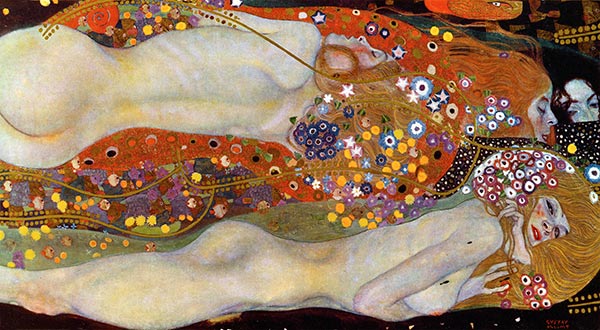
Adele Bloch-Bauer was the Viennese wife of sugar baron Ferdinand Bloch-Bauer and the only woman whose portrait Klimt painted twice. American showbiz icon Oprah Winfrey owned the second portrait and sold it to a Chinese collector in 2016 for $150 million. She had previously bought the painting from Christie's in 2006 for $87.9 million. The painting was one of five Klimt canvases seized by the Nazis from Bloch-Bauer's husband during World War II, and became the subject of a 2015 film Woman in Gold, starring Helen Mirren. But it's not Klimt's most expensive work; that accolade goes to 1904 canvas Water Serpents II (pictured), which was sold privately by Russian billionaire Dmitry Rybolovlev in November 2015 for $170 million, also to an Asian buyer.
Klimt's work blazed a disparate art trail; sixth-century Byzantine mosaics from Ravenna he found of "unprecedented splendor", and they influenced his Woman In Gold canvas along with others; there was also Victorian repression and its palette, along with its opposite, a newfound freedom of expression and sexual liberation in his subject matter through lush, symbolic canvases. Klimt's female subjects were seen as depicting a new counter-conventional woman. From decorative to theatrical to portrait, his work evolved as his stature and financial independence grew, emboldening him more. The eccentric artist wore a caftan when he painted and kept a pet cat. He was no slacker in the bedroom, either-Klimt sired 14 children and was never married.
As such, Klimt was a divisive force. Admirers saw in his friezes magnificent stylized illustrations of the duality of Eros and Thanatos, of Love and Death. Detractors saw only pornography and misogyny, the latter a more recent reaction to Klimt's work.
Stylistically, something pioneering happens with a Klimt canvas, whereby the anatomy of the models becomes ornamentation, and the ornamentation becomes anatomy; like a more fashion-motivated Matisse. During Klimt's golden period, the clothing on the models become tapestries of abstract shapes rendered in rich golds, reds, blues and greens. And even when Klimt painted with no human figures, his flowerscapes or landscapes were filled with organic forms, as though fields of flora had become flowing trains of costume.
In this way, Klimt foreshadowed just about everything in 20th-century art. He was both art nouveau and art deco, pre-cubism, pre-Bauhaus and even pre-Russian constructivism. He was the sensorially advanced aristocrat of art, a technician with a wild mind and disciplined eye, whose voluptuous irradiations lit the luxurious way ahead for all the art that followed.
See this intoxication of color at Atelier des Lumieres in Paris, which presents an immersive exhibition devoted to the leading figures of the Viennese art scene, of which Klimt was the icon. To mark the 100th anniversary of the painter's death and that of his mentee, Egon Schiele, their works have been brought to life to the sound of music on the former foundry's vast projection surface in the City of Light's 11th arrondisement on Rue Saint-Maur.
Klimt's canvases are stunning, gilt-edged moments to behold. The fine layers of gold leaf lend his work a timeless quality, and the absence of perspective and shadow made his subjects resemble religious icons. Few artists have produced output of such high order-and dazzling high style-as Klimt.