



Dali in 1995: A personal 'Heaven on Earth'









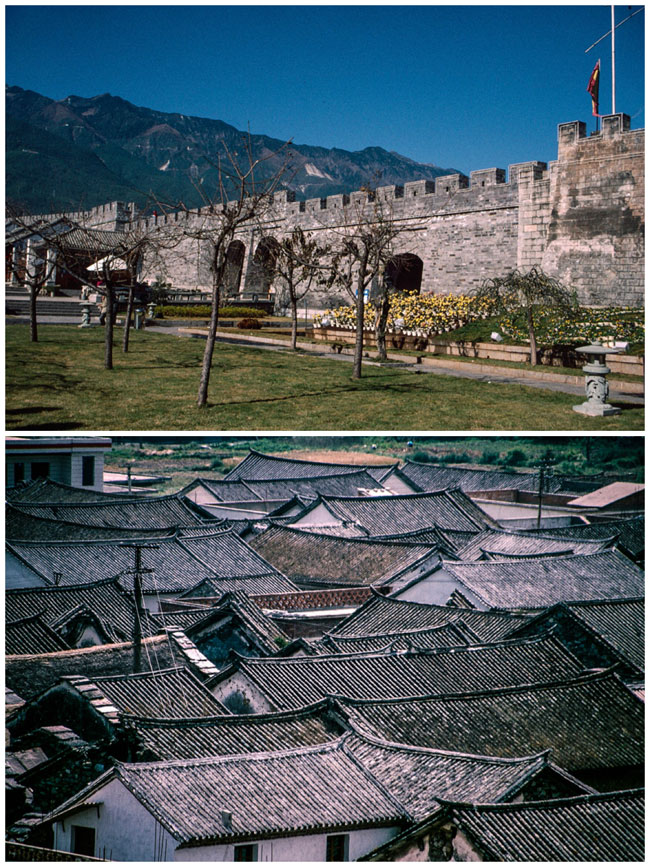
Why the strong fortifications? Throughout its history, Dali has witnessed turbulent periods of battles and attacks, including from the 13th century armies of Genghis Khan, when the city was destroyed. It had been capital of both the eighth and ninth century Bai Kingdom of Nanzhao and the Kingdom of Dali (937-1253). Today’s old town was laid out in the late 14th century during the Ming Dynasty.
Dali, seen as ”an ancient capital at the crossroads of Asian culture” throughout its history, has served as a gateway to cultural, commercial and trade exchanges between China and Southeast Asia.
Indeed in the 1980s, foreign visitors were often following routes up from Thailand, for example, to Guangxi and Yunnan, with Dali as a top destination.
From the South Gate I walked with increasing fascination along Fuxing Lu, struck by its historical feel that was then hard to come by within China’s rapidly modernizing eastern cities. Its distinctive two-floor whitewashed buildings, traditionally constructed of stone and fronted by red painted wood, lined the streets, with many shops open for business. Within the town walls, five streets ran north-south and eight east-west. There was very little motorized transport and the streets were thronged with a mixture of people. Dali is the Bai heartland, but there were also sizable communities of Naxi, Yi, Miao, Hui and other ethnic groups. Bai women stood out for their brightly decorated costumes and distinctive large, white headgear. (“Bai” incidentally means “white” in Chinese.) Many of the women wore large bamboo baskets or infant harnesses.
During my early Dali adventures, there were none of today’s large or luxurious hotels. Instead there were small hostels, guesthouses and inns. Some had long histories, others were more recent, but almost all featured a local style of architectural design. Some incorporated courtyard gardens where guests could enjoy breakfast or sip drinks in the evening while listening to local music. My residence in 1995 was a Bai house with balconies that overlooked the tiled roofs of the old town toward the forested slopes of Cangshan Mountain. Very quickly I felt I had come upon a personal heaven.
Back out walking, I followed Fuxing Lu to the North Gate, climbing up to enjoy a view above the town and surrounding area as well as gaze down on the many horse-drawn taxis waiting to carry locals back to their villages either on the mountain slopes or on the plains toward the lake.





