



Chinese researchers must adopt a more long-term perspective









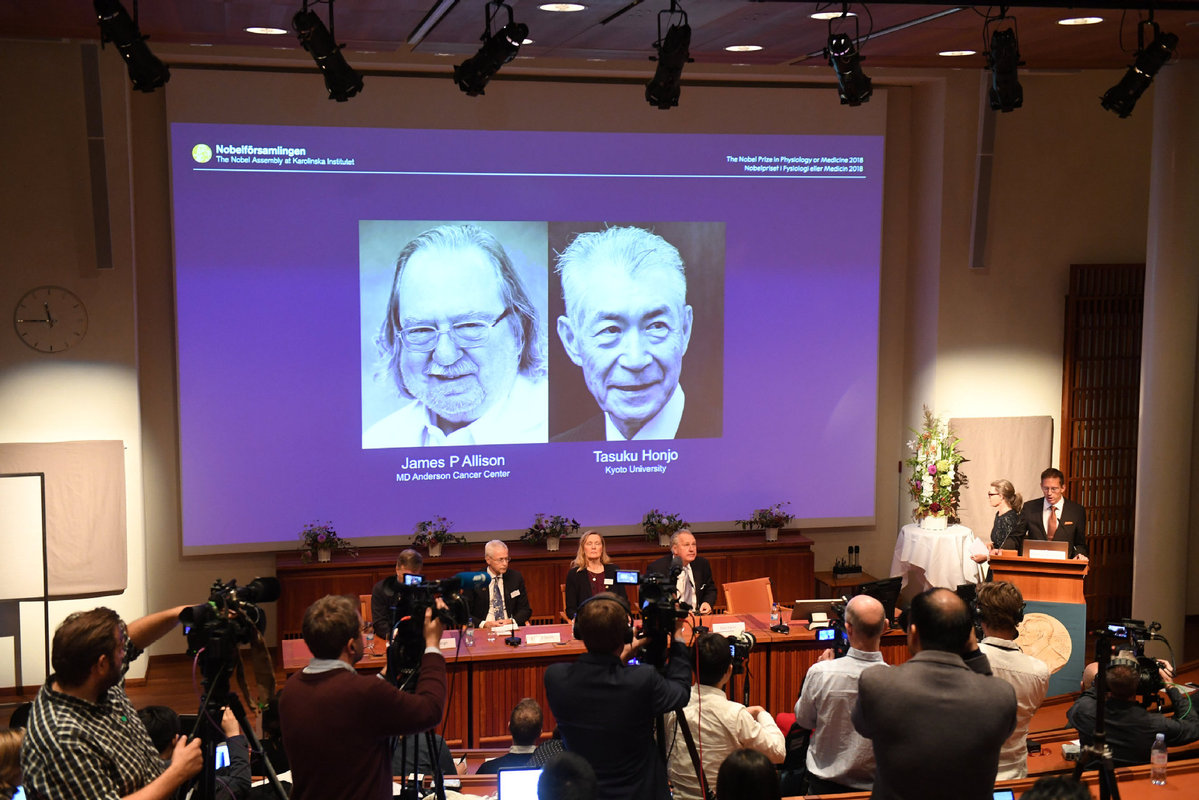
Japan's Tasuku Honjo, a professor of immunology of Kyoto University, won the 2018 Nobel Prize in medicine, together with the James Allison, a professor of immunology with the University of Texas of the United States, for their research that has revolutionized the treatment of cancer last week. Xinhua News Agency comments:
Japanese scientists have brought home 18 Nobel Prizes over the past 18 years, during which their Chinese counterparts have secured only one-pharmaceutical chemist Tu Youyou, won the Nobel Prize in Medicine in 2015 for her groundbreaking work on malaria in the 1960s.
Undoubtedly, China can learn a lot from Japan on how to strengthen its scientific research. Long-term stable support for fundamental research, a strong crisis awareness, and paying great attention to cultivating young scientists and researchers are the three pillars of Japan's scientific research success.
Surveys on Nobel laureates in science and economics since the 1940s have shown that the average time interval between their winning of the prize and their prize-winning discovery is 26 years. In other words, few Nobel laureates had really thought about the honor when they began the research that led to their key discoveries. Their work was driven by their curiosity and academic interest.
However, many Chinese scientists are eager for quick success and instant benefits, and their research is mostly oriented toward obtaining government funds or quick industrialization. Few are willing to dedicate years to difficult fundamental research that may not result in any concrete findings.
Also the research assessment system in China is focused on the number of papers researchers publish, not the quality of their work. And the number of theses published in China and the increase of China's input into research in recent years have dwarfed many other countries, including Japan.
The white paper books on science and technology published by the Japanese government each year, meanwhile, indicate the number of papers published by Japanese scientists has declined slightly since 2004, and the Japanese government's input into research and development only increased 15 percent from 2000 to 2018.
China needs to attach more importance to the quality of it research, providing more incentives to encourage fundamental research and further improve the efficiency of its input in research and development.





