



US strategy will fail if it doesn't offer DPRK the right incentives









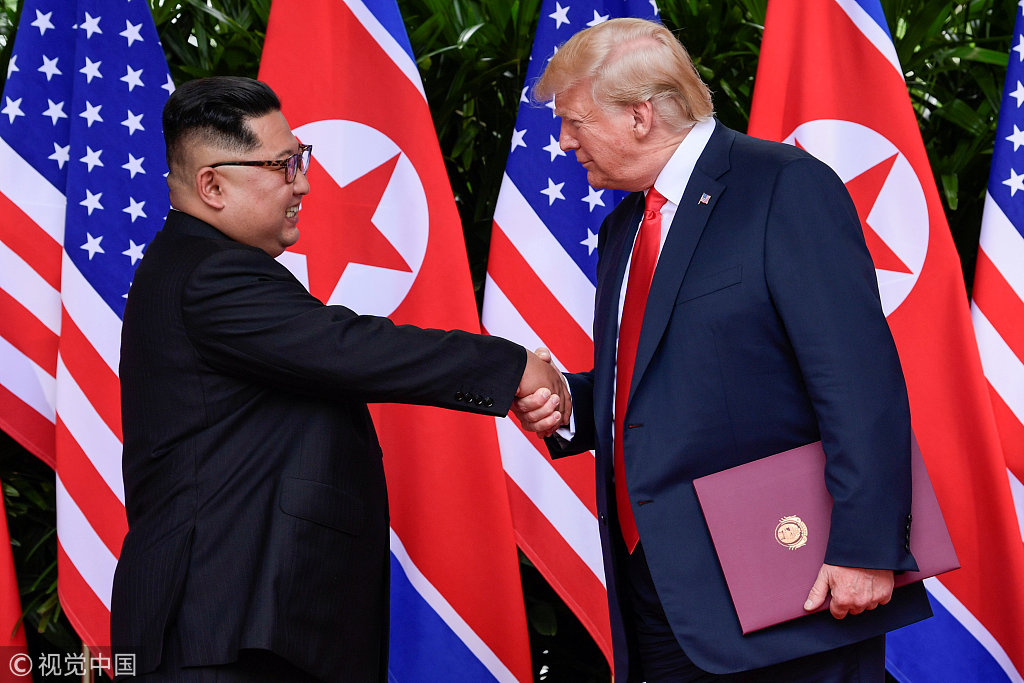
US President Donald Trump's policy toward the Democratic People's Republic of Korea can be described as "coercive diplomacy". The United States applied "maximum pressure" on the DPRK in 2017 and used "diplomatic engagement" in 2018 to denuclearize the Korean Peninsula. Maximum pressure and diplomatic engagement may seem contradictory features, but they are actually an organic whole, with the first being the tool and the second the goal. Coercive diplomacy simply means forcing a country to stop or begin an activity by using limited force or threatening to use force.
The US has been using coercive diplomacy against other countries since the end of World War II. According to studies by scholars, including Peter Viggo Jakobsen, successful coercive diplomacy is supported by four conditions: a limited use of force or the threat to use force to compel a country to abandon its objectives; a deadline for compliance; an assurance to the target country that compliance will not lead to more demands; and an offer of incentives for compliance. Credible threat to use force and credible assurance of incentives are key to the success of coercive diplomacy.
Trump used the first two conditions well against Pyongyang, which most likely changed Pyongyang's nuclear stance.
First, in terms of economic sanctions, the Trump administration pushed for "comprehensive sanctions", which included multilateral sanctions imposed by the United Nations and "secondary sanctions" by the US, which was starkly different from the targeted sanctions of the past.
The targeted sanctions were aimed at hurting the DPRK departments, companies and individuals that were directly involved in its nuclear and weapons programs. But they ended up harming the general public in the country and causing humanitarian crises, something the sanction imposers intended to avoid in the first place. That explains why Pyongyang managed stable economic growth despite the targeted sanctions.
But since comprehensive sanctions led to overall economic and financial blockade of the DPRK, and a halt to its economic exchanges with the outside world, it produced results different from the past.
Second, the US used the threat of a military strike against the DPRK convincingly, as it combined it with military preparations. Apart from the Bill Clinton administration, which in 1994 announced it was ready to resolve the DPRK nuclear issue through military means, which threw the DPRK into something of a panic, the other US administrations have used only military drills in and around the Korean Peninsula to warn Pyongyang.
Third, as part of its strategy, the US tried to diplomatically isolate the DPRK. Thanks to US pressure, since last year countries such as Portugal and Jordan have severed diplomatic ties with the DPRK, and Mexico, Peru, Kuwait, Spain and Italy have expelled the DPRK's ambassadors. Besides, countries such as Thailand and the Philippines have significantly reduced bilateral trade with the DPRK.
The change in Pyongyang's nuclear stance therefore can be mainly attributed to Washington's "coercive diplomacy".
Yet the US-DPRK denuclearization talks seem to have hit a hurdle. Perhaps Trump's overemphasis on "credible threat" and neglect of the "credible incentives" are to blame for that. As Stanford professor Alexander George, who coined the coercive diplomacy term, said, for coercive diplomacy to succeed, both "sticks" (coercion) and "carrots" (diplomacy) need to be used, and skillfully maneuvered.
If the Trump administration overuses maximum pressure and fails to offer sufficient incentives (such as credible long-term security guarantee and economic compensation), why would Pyongyang abandon its nuclear program? If the threat to a country's safety and security is not eliminated, it would choose to resist rather than kneeling down in the face of maximum pressure. After all, resistance offers a better chance of survival.
So, if it wants the DPRK to abandon its nuclear program, the US must show the courage and determination to make a bold deal with the DPRK. And it should have practical, specific, and detailed plans on such issues as lifting of sanctions, security guarantee, and economic compensation once the DPRK abandons its nuclear program. Or else, Trump's coercive diplomacy will fail.
The author is an assistant research fellow at the China Institutes of Contemporary International Relations.
Source: chinausfocus.com





