Last stand of the great green peacock









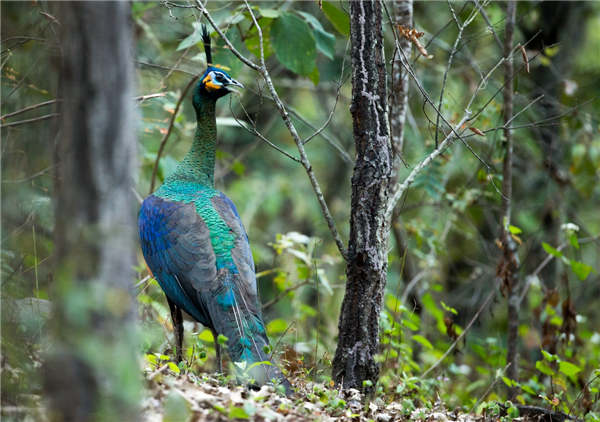
Archaeological findings, including bones excavated in central Henan province dating back 4,000 years suggest that green peacocks were widely distributed south of the geographical line marked by Qinling Mountains and Huaihe River.
"However, because of the destruction of habitats and hunting, green peacocks have disappeared in these regions gradually, especially in modern times," Gu said.
He found very little modern research about the species, just nine papers in Chinese and one in English. These papers, mostly written in the 1980s and 1990s, suggested that Yunan province had become the only region with wild green peacocks in recent decades. In fact, it is regarded as a name card of Yunnan province.
The last comprehensive survey on distribution of China's wild green peacocks was done by the Kunming Institute of Zoology of the Chinese Academy of Sciences and published in 1995. It estimated that between 800 and 1,100 green peacocks lived in Yunnan.
However, a rough survey by the same institute two years ago estimated that the entire population had fallen to fewer than 500, and that they lived in disparate small groups, reducing the chances of propagation.
"You could easily see that in many places green peacocks had lived in 20 years ago they had simply vanished," Gu says.
One problem is that green peacocks are picky about their living environment, he says.
River valleys with gentle slopes and tropical monsoon forests offer the bird proper humidity, sufficient food, drinking water and open space, making them ideal habitats for it.
However, in southern and southwestern Yunnan, large areas of such environment have been reclaimed as farmland for tropical crops like banana and rubber trees in recent decades. The loss of former habitats has forced the species to retreat to remote river valleys, such as the river valleys along upper and middle reaches of the Honghe River.
Gu's joy at finding the habitat was short-lived. Within months, on one of his subsequent visits to the area, it became clear that these great survivors were now threatened by a hydro power station being built along the river.
With building of the station, operated by a local water resources company, proceeded trees were felled and there had been heavy excavation work, severely damaging the environment, Gu says.
"Surveying the scene made me very sad."