



Arctic permafrost thaw a climate threat









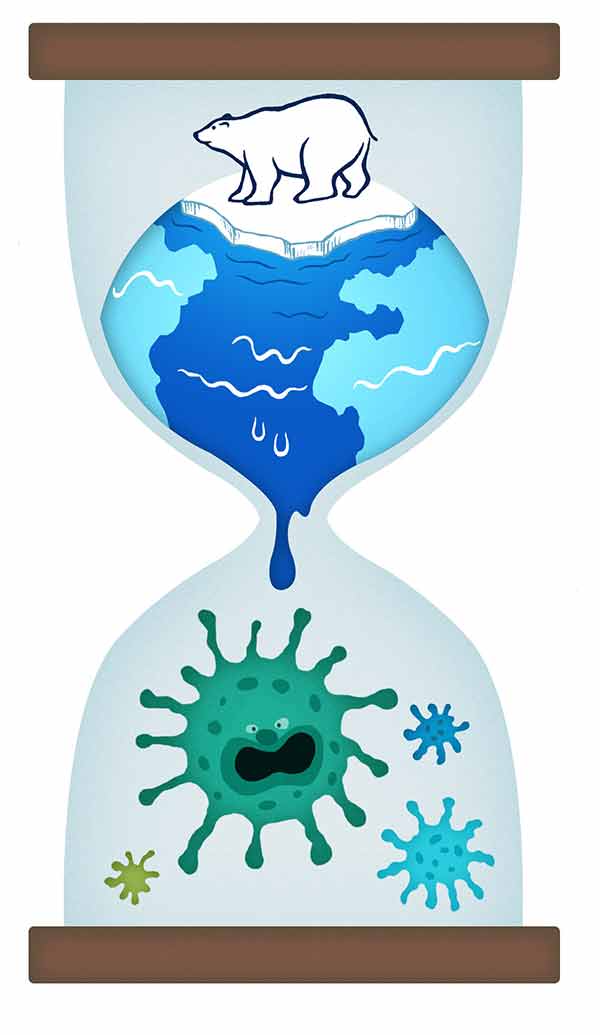
The permafrost in the Arctic, which has one of the largest natural reserves of organic carbon in the world in its soils, is thawing and diminishing.
So what's the problem? When permafrost (or frozen dirt) melts, soil microbes trapped in it become active again and eat their way through the available organic material (or carbon), turning it into carbon dioxide and methane. These greenhouse gases then enter into the atmosphere and intensify global warming.
In other words, thawing softens permafrost, and turns ice into water causing the surface area to collapse, or subside. The resultant sinkhole then turns into a lake-a thermokarst lake-that in turn hastens the overall melting process. Indeed, a vicious circle.
A new study conducted by US and German researchers shows such lakes-by turning the organic carbon, stored in Arctic soils for 2,000 to 43,000 years, into CO2 and methane-pose a big threat to not only the Arctic but also the rest of the world. According to a United Nations study, the release of greenhouse gases in the Arctic has increased 25 to 90 percent compared with the period when the region's climate condition was relatively stable.
Worse, once the Arctic permafrost thaws, the dormant soil microbes, that is, different types of bacteria, could spread across vast swathes of the planet posing a potent threat to human health. According to some media reports, scientists say two types of nematodes, frozen in the Arctic for 42,000 years, could become active again. Which means not only single-cell organisms but also multicell organisms could spring back to life once the Arctic ice and permafrost melt.
In the summer of 2016, Siberia experienced an anthrax outbreak that infected more than 20 people and claimed the life of one child. Animals were the worst affected, as more 2,300 reindeer died. Later studies showed the anthrax bacteria spread from the carcasses of some reindeer that died of the disease in 1941. It was the thawing ice and diminishing permafrost that exposed the carcasses and revived the dormant anthrax bacteria.
Bacteria are not the only threat. Billions and billions of viruses in the permafrost and ice, even in bacteria, can come back to life if the Arctic thawing accelerates. In 2015, researchers found a giant virus called mollivirus sibericum, which is 30 times bigger than an ordinary virus and as big as a bacterium, and contained 1,200 genes.
Mollivirus sibericum is the largest virus ever found. Before it was discovered, it had been lying dormant in the frozen Arctic for about 30,000 years. Fortunately, though, it can only affect amoebas, not humans. But then viruses can mutate!
Since the thermokarst lakes could pose a big threat to humans in the future, it is the responsibility of all countries, especially those that are more advanced in science and technology, to take urgent measures while working together to slow down the melting of the Arctic.
The author, a former researcher at the Chinese Academy of Medical Science, is a popular science writer. The article was first published in Beijing News in Chinese.





