



China's empresses get their day









Salem, MA - Chinese imperial women were a special group of people throughout history. As wives of the most esteemed people in the country, they readily inspired imaginings about how magnificent their lives must have been. But because written records and documents focus more on the men, the empresses’ lives have largely remained shrouded in mystery.
Aiming to pull back the veil on the untold stories of Chinese women rulers, an exhibition is being presented at the Peabody Essex Museum (PEM) in Salem, Massachusetts. Called Empresses of China’s Forbidden City, the exhibition features hundreds of spectacular objects from the Chinese palace from four centuries.
“This is the first major exhibition to explore the role of empresses in China’s last dynasty, the Qing Dynasty from 1644 to 1912. In many respects, it’s quite surprising that this topic hasn’t been tackled before,” said Lynda Roscoe Hartigan, deputy director of PEM.
The exhibition, which opened on Aug 18, features more than 200 works including portraits, jewelry, garments, Buddhist sculptures and decorative artworks from the Palace Museum in Beijing and the Smithsonian in Washington. Many have never been publicly displayed before.
The result of four-plus-year collaborative effort between experts from the US and China, the exhibition comes with an undertone of the two countries’ cultural exchanges and dialogues.
“This exhibition — I think quite fittingly and quite frankly deliberately on the part of the two institutions — coincides with the 40th anniversary of US-China diplomatic relations,” said Hartigan.
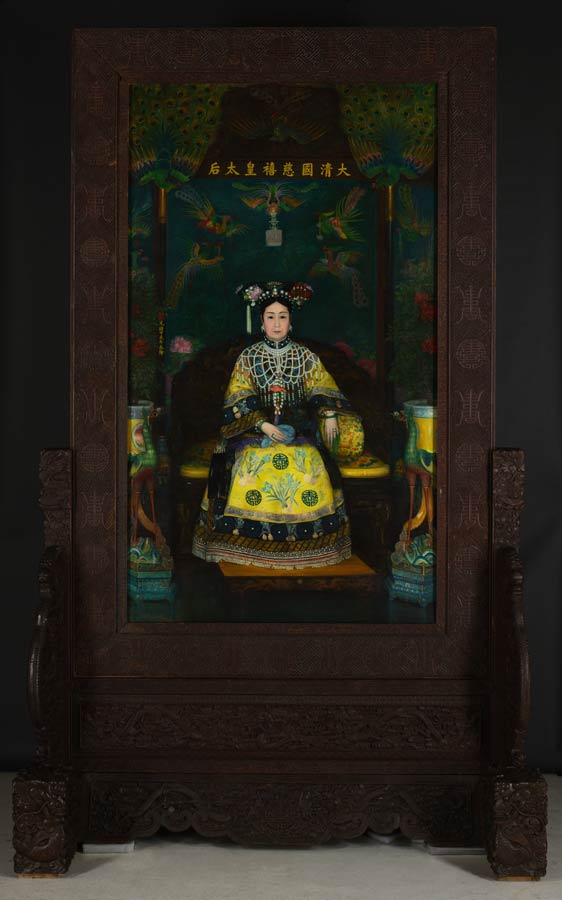
One star piece showcased was a 16-foot-tall oil painting of Empress Dowager Cixi, painted in 1903 by American artist Katharine Carl, the first-ever female court painter in China.
The painting was later sent to the US to be shown at the 1904 World’s Fair in St. Louis, and then given to US President Theodore Roosevelt in 1905 as a gift.
“It embodies the fact that the countries, China and the US, have had a long partnership, many ways of working together, and we think this painting shows some of that feeling,” said Jan Stuart, co-curator of the exhibit and curator of Chinese art at the Smithsonian’s Freer and Sackler galleries.
“It’s very timely that we can look at the Forbidden City from a fresh perspective — that is from a woman’s perspective,” said Daisy Yiyou Wang, PEM’s curator of Chinese and East Asian art.
“This exhibition is thrilling in that it opens a silent yet colorful book about how these women helped shape the course of history,” she added.
“One of the themes for our exhibition is for people to understand that women in this last dynasty have ways to show personal taste and spiritual life,” said Stuart.
Lucas Dileo, a Boston resident who is a regular visitor to China, said it was his first time seeing the Chinese empresses in the US.
“Often exhibitions on Chinese history and arts show more of the permanent aspects, like the bronzes, the different bowls, some fabrics and scrolls. A chance to tell the life of someone who made an imprint on history makes it very special,” Dileo said.
“Particularly in these days, women are taking more and more important roles across all society. It’s good to be reminded that at a time in the past, they also played important roles in major countries around the world,” Dileo added.
The curators traveled multiple times to the Forbidden City in Beijing. With the help of Chinese experts from the Palace Museum, they selected from the vast treasures the most representative pieces.
“I was impressed by the Empress Xiaoxian, who had a poem written for her,” said visitor Carol Lutes.
Xiaoxian passed away at the age of 36, and her heartbroken husband, Emperor Qianlong, brushed a poem to mourn his beloved wife. Visitors can listen to the poem recited in English while examining the original copy on display.
The exhibition will run at PEM through Feb 10, 2019.
Judy Zhu contributed to this story.










