



China’s reform and opening-up policy: A successful paradigm









China, one of the ancient civilizations, has left a significant mark on the world’s economies and is on the verge of becoming No 1. But this phenomenal journey is full of travails and the statecraft of great Chinese leaders who have guided the country with diligence. Deng Xiaoping is the pioneer of China’s recent development and has played a vital role in successfully initiating economic reforms. In 1978, he led China through comprehensive market economy reforms and an opening-up policy that transformed China into a receptive society for foreign investors and a place providing numerous opportunities for locals. After that, China experienced a drastic change in shifting the country from its unsteady early economic trajectory to a more sustainable path.
During the past 40 years, China has experienced tremendous development in all major sectors including manufacturing, international trade, transport infrastructure and smart city solutions. These changes have pivotal importance that has not only impacted the lives of Chinese citizens but also proved beneficial for foreigners.
Briefly, the reform was market-oriented and initially based on a planned economy model of the Soviet Union. This model certainly increased productivity and the national economy but also had some problems. In order to counter these problems, a market-based approach was adopted, which established market-based institutions and systems. So the new market reform maintains equilibrium between the planned economy model and a market-based approach. On the other hand, the opening-up policy is based on widening trade limits and consists of three main stages.
The first stage was during the 1980s and 1990s, where the main goal was to cater to foreign investment in domestic industrial projects and infrastructure. During this phase, Guangdong, Shanghai and Fujian underwent rapid growth.
The second was from 2001 to 2012 when China was in compliance with the World Trade Organization. During this stage, two main goals were achieved -- bringing foreign trade and investment in line with international rules and making China an integral part of global value chains.
The third stage kicked off in 2013 with the Belt and Road Initiative. This is expected to enhance mutual interests and harmonize development among participating countries. Therefore the initiative defends world peace and appreciates innovative, creative and inclusive development globally.
Some of the prominent projects initiated under China’s reform and opening-up policy include the manufacturing sector, which has been the most vibrant aspect with the largest production output in 220 out of 500 major industrial products. In 2016, Deloitte’s Global Manufacturing Competitiveness Index crowned China because of its high-tech manufactured products with value addition and export value that outperformed US products. The transport infrastructure has been amazing in expediting exports to destinations in a safe and timely manner.
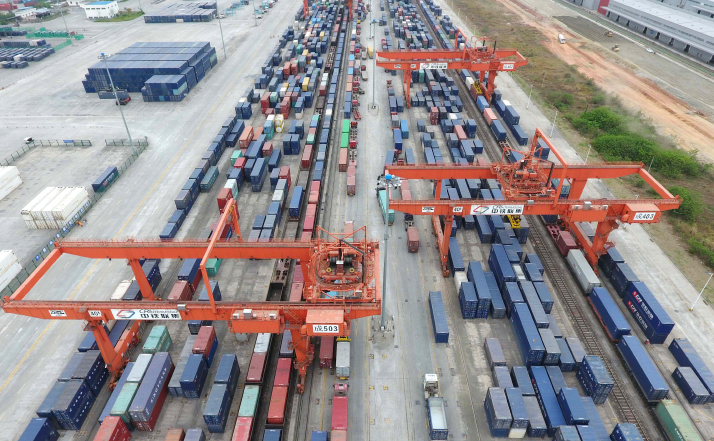
As part of the reform and opening-up policy, China has been developing viable transport alternatives. The recent China-Europe freight rail is an excellent example. During a trial service test, the freight train traveled from Shenzhen, China, to Dartford, United Kingdom, covering a distance of roughly 5,000 miles in a 23 days and moving goods through nine countries. According to transport experts, the rail option can deliver a transit time of 20-23 days in comparison with 35-40 days for sea freight. So, this trial proved to be an innovative approach to shorten the distance, time and security of goods, adding value to exports.
Chinese telecom equipment manufacturers are also active under the reform and opening-up policy. They are fully involved in providing smart city solutions on an international platform, such as ZTE Corporation, which represented China during a recent international fair in Greece on Sept 10, 2017.
In light of the historical background of China’s reform and opening-up policy as well as its roadmap with significant projects in China and around the world, it’s clear that the policy initiated by Deng Xiaoping is unprecedented and has left a positive impact worldwide.
Khurram Raza is a student from Nanjing University of Science & Technology.
The opinions expressed here are those of the writer and do not represent the views of China Daily and China Daily website.





