



Explainer: The science behind chromosomes









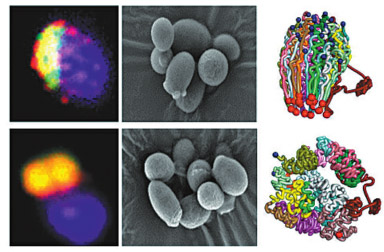
On Thursday, it was reported that by editing chromosomes, or the DNA molecules that carry an organism's genetic information, Chinese scientists have created a yeast strain with all the genetic information fused into a single chromosome, rather than the customary 16 for this species.
Tang Cheng, a doctoral candidate on genetic editing at Chinese Academy of Sciences, wrote via WeChat public account iScientist:
Chromosome carries the main genetic material of the cell. Each human somatic cell carries 23 pairs of chromosomes.
Above are two facts known to everyone who has received basic natural science education. However, the following things might be unknown to most people.
First, the number of chromosomes a cell carries has nothing to do with its complexity or size. Yeast strain has 16; The male of myrmecia pilosul, a kind of ant in Australia, has only one; Ophioglossum reticulatum, a kind of small fern, has 1,260.
Second, the number of chromosomes has nothing to do with the number of genes they carry. For example, fission yeast has similar genes with yeast strain, yet the former has only three chromosomes.
In one word, the only rule about the number of chromosomes a cell carries is there is no rule. For the past several decades, scientists tried to change the number of chromosomes of a cell without changing the genes they carry, but all their efforts failed.
That’s why the recent research by Chinese scientists is called a “breakthrough”. On Thursday, two influential essays were published online by Nature, with one submitted by Jef Boeke team from New York University, which combined the 16 chromosomes of yeast strain into two; The other one comes from the Qin Zhongjun team at Shanghai-based Chinese Academy of Sciences Center for Excellence in Molecular Plant Sciences, which combined the 16 chromosomes into one.
More importantly, after its 16 chromosomes are combined into one, the yeast strain remains the same and its genes still get normally expressed. They have even found that the combination of chromosomes has changed the structure chromatin without casting major influences on the genes, which might very possibly overthrow existing theories.
Therefore, it is not exaggerating to say the achievement might revolutionize a key field of life science. More questions emerge with the achievement:
Is there an upper limit to the length of chromosomes? Since one chromosome is enough, why do most eukaryotes have multiple numbers of chromosomes? When yeast strains’ 16 chromosomes are combined into eight, reproductive isolation emerges between the new ones and the old ones that have 16 chromosomes, why?
These questions are waiting for our answers. Hope scientists will answer them soon.





