


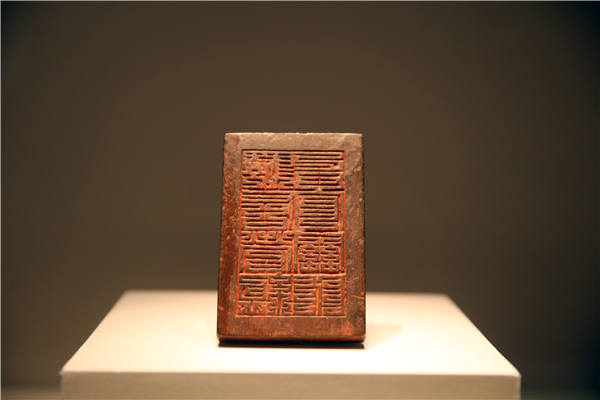
Their discovery verified that when Zhang's fleet battled an army led by a Ming general on the river, he was forced to relinquish the wealth on board. Furthermore, it was clear that the items dragged up from the depths would help modern-day researchers examine further the social, political and military situation during the late Ming to early Qing (1644-1911) dynasties.
Their surprising findings immediately ranked in the top 10 Chinese archaeological discoveries of 2017. And now a selection of the artifacts from the same excavation and a subsequent dig earlier this year are being shown at the National Museum of China until Sept 26.
The exhibition, titled Sunken Treasures in Jiangkou Battlefield, opened a series at the national museum dedicated to recent important archaeological findings. A second exhibition is currently displaying a plethora of jade objects and pottery found at a neolithic site belonging to the Dawenkou culture near the city of Jinan, Shandong province. A third exhibition shows an impressive range of artifacts from the Sanxingdui, Jinsha and Qingyanggong sites in Chengdu, which will shed light on the mysterious ancient State of Shu, an era that spanned from the 18th century BC to the second century BC.
When archaeologists began work at Jiangkou in January 2017, a cofferdam had been built to enclose an area of nearly 10,000 square meters where the river water had been pumped out.
"Many people living nearby said it was the first time they ever had seen the riverbed," says Gao Dalun, director of the Sichuan Provincial Cultural Relics and Archaeology Research Institute, who oversaw the excavation. "They said the excavation seemed more interesting than the treasures to be found."
Archaeologists were keen to solve this historical riddle, but found themselves in a race against time as they had just three months to complete their work while the water levels of the Minjiang River were at their lowest. They also had a hard time fending off thieves attempting to steal the relics.





