Vital for EU to make China part of Eurasian plan









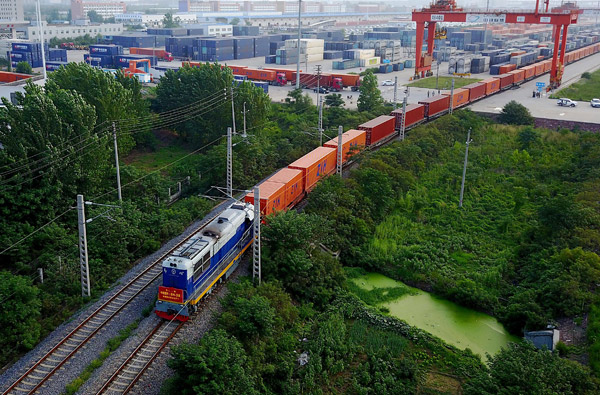
Almost five years after President Xi Jinping proposed the Belt and Road Initiative, the European Union is trying to convince its 28 member states that boosting connectivity across Eurasia continent is crucial for their economies. The EU is expected to announce its strategy on connecting Asia and Europe at the 12th Asia-Europe Meeting in Brussels in October.
In a world fraught with the dangerous trends of isolationism, extremism and populism, any effort, even intention, to improve connectivity should be treasured as a public good. While the EU is still giving final shape to the text of the strategy, more such efforts across the world are badly needed.
Historically, China and Europe have made great efforts, even succeeded to a certain extent, to bring the Eurasian people together. Centuries ago, our Chinese ancestors, who braved the land and the sea to establish trade routes connecting Asia, Europe and Africa, could be called the "first-generation harbingers" of globalization.
They were followed by such great European explorers as Marco Polo (1254-1324), Christopher Columbus (1451-1506) and Ferdinand Magellan (1480-1521). The European explorers charted newer courses to discover the New World and a sea route to Asia.
The discovery of these routes and new territories furthered international trade, although it also had serious geopolitical and social consequences. After the end of World War II, mainly through the intensified activities of big corporations, Europeans and Americans facilitated the expansion of global trade and investment. For the past four decades, this expanded global trade, or globalization, has greatly helped China to increase its economic strength.
Since the beginning of this century, especially after the 2008 global financial crisis, the world has also benefited from China's rapid and steady economic growth, which on average has contributed 30 percent to the annual global growth.
The goal of the Belt and Road Initiative is to sustain China's global contribution and help the world substantially tap the market potential of more than 1.3 billion Chinese people. And to realize that goal, China is making efforts to improve connectivity and lift barriers between the Chinese people and the people who share the Eurasian continent.
Geographically, countries in Eurasia are advantageously placed to establish closer economic ties with their neighbors and other countries.
Seizing the opportunity offered by the Belt and Road Forum for International Cooperation in May 2017, I visited 10 European countries to seek the views of as many politicians, businesspersons and academics as possible on the initiative's interconnectivity projects. In general, they said Western Europe and East Asia had become the driving forces of global development and people are eager to benefit from global development and prosperity, and want poverty, wars and conflicts to end.
China and the EU are not the only economies promoting regional connectivity. Russia, Mongolia, India and Indonesia, too, have announced regional development projects to increase their say in regional and global affairs. Even within the EU, countries such as Greece, Poland and the Czech Republic want to maximize their role as a gateway to their respective regions.
The China-proposed Belt and Road Initiative respects the idea of common prosperity and peace. For example, China has said the initiative's projects could be synergized with the development plans of the Shanghai Cooperation Organization members-as the SCO Summit that concluded in Qingdao, Shandong province, on Sunday highlighted.
Inclusiveness is at the core of the Belt and Road Initiative. And inclusiveness facilitates peace and common prosperity. The EU is a project of peace and its new strategy of linking Europe and Asia is expected to keep in mind the original motive.
As such, hopefully deepening cooperation with China to explore further synergy will be part of the EU plan for connecting Asia and Europe.
The author is deputy chief of China Daily European Bureau.
fujing@chinadaily.com.cn