


China, Spain celebrate an evening of ancient court music










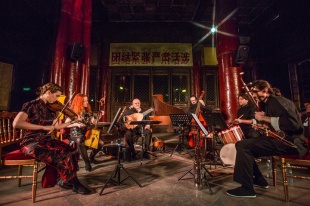
According to Ruben Garcia Benito, one of its two musicians, the band took up ancient Chinese music in 2012 when they were living in Beijing. Since then, they have returned to China for a few weeks every year to learn more about Chinese instruments at the Shanghai Conservatory of Music.
They wanted to popularize the music with Spanish people because little is known about China's thousands of years of musical history in the country.
The other band taking part in the concert was the Iliber Ensemble, a chamber music group that specializes in performing baroque music using ancient instruments.
The two bands started working together on the project a year ago. According to Benito, the repertoire of the concert was designed to follow Pandoja's path from Spain to Macao and then on to Beijing.
Most of the musical pieces were rediscovered at libraries and museums, among which, the sonata pieces by Teodorico Pedrini were found in the National Library of China.
Benito says that he has been looking into dozens of academic papers, not only about Pantoja, but also about the lives of missionaries in the Chinese imperial court.
The concert attempted to highlight the links and differences between the Chinese and Western styles of music. "The origins of producing music might have been the same, but then the Chinese and the West went off in two different directions, with uniquely beautiful results," says Benito.
The concert, which was part of the 18th Meet In Beijing Arts Festival, was jointly held by the Cervantes Institute in Beijing and the Spanish embassy to China to commemorate the fourth centenary of the death of Pantoja.
In the early 17th century, he wrote a letter from Beijing to the Bishop of Toledo in Spain, giving a detailed introduction to life in China, including details of its geography and economy, as well as the country's history, religion and politics.
The letter was believed to represent the most comprehensive and objective understanding about China by a European native at that time.
"Pantoja was a key figure in helping the Spanish to learn about Chinese culture," says Alberto Carnero, the Spanish ambassador to China.
"It was due to his efforts that Spanish people began to develop a direct knowledge of China." Carnero says.