Surveys hail the rise of the robot taxis









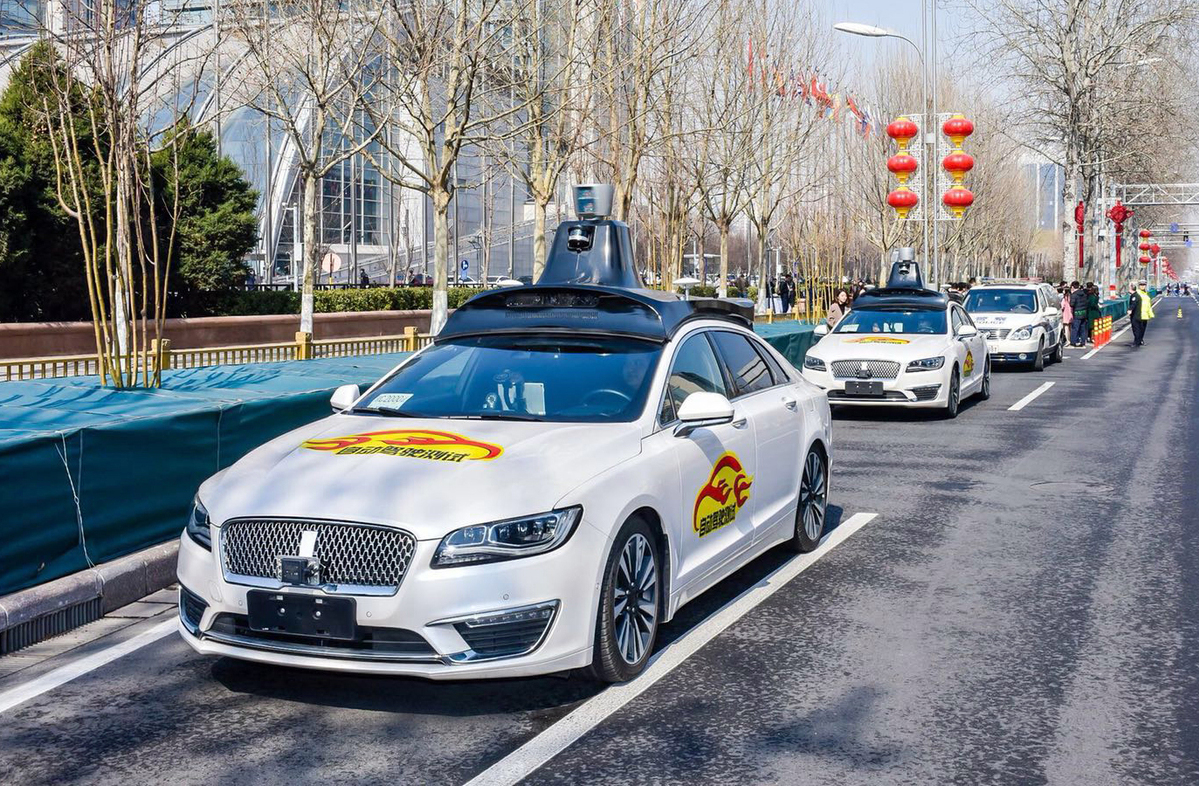
Chinese customers in general have warmed to autonomous driving vehicles this year, while more younger people preferred human driverless taxis - but experts are divided on the challenges that automakers face.
A Deloitte Global Automotive Consumer Study found, in its latest report released in June, that the Chinese market has the lowest percentage of consumers who think fully autonomous driving vehicles will not be safe in Asia-Pacific region, and this level of doubt is seen decreasing.
The study found that only 26 percent of Chinese respondents believed robot vehicles wouldn't be safe, significantly lower than 62 percent in 2017. The latest figures for China, indicating that its consumers are more flexible when it comes to the disruptive changes brought by new technologies in this area of the auto industry, puts it well in front of Japan, South Korea, India and Southeast Asia.
German consultancy Roland Berger came up with similar findings, saying China topped its Automotive Disruption Radar, a trend which had contributed to pushing driverless mobility from concept to reality.
"Robot car services, without human drivers, are the future of the taxi and car hailing industry and that's becoming very clear," said Ye Liang, a Shanghai-based principal in Roland Berger Consultancy China. "This is where mobility service providers, including DiDi Chuxing, are heading and they are working on it aggressively," he told China Daily.
Robot car services are chauffeur-less taxi riding services provided by completely autonomous driving vehicles.
This kind of new service attracted a total of 80 percent of Chinese car users' preferences, well beyond the 55 percent global average, when asked for the first time in an Automotive Disruption Radar survey.
Customer interest in new mobility services has jumped this year, and the numbers of young Chinese who would switch from car ownership to robot car services, if they cost less, rose from 10 percent to 40 percent. The German consultancy's Automotive Disruption Radar, released in April, is a biannual analysis of market trends related to disruption in the global automotive industry.
It surveyed 13,000 car users in 13 countries including the United States, Germany, the United Kingdom and Sweden.
"The automaking giants are also getting themselves prepared for the next biggest trend, by taking over mobility service providers, to avoid ending up as hardware providers," Ye said.
He added that carmakers who became suppliers to and serviced "brandless fleets," would make much thinner profits while losing direct contact with end users.
Some ambitious automakers are dipping their toes in no-chau! eur car sharing services. Daimler AG and BMW Group have bought Car2Go and ReachNow, and are providing services with Smart and BMW i3 and Mini vehicles respectively.
The two German luxury carmakers announced earlier this year they would merge their worldwide car sharing business Car2Go and ReachNow, to better defend their market positions against new mobility service providers including Uber and Didi Chuxing.
The Deloitte report found that consumers said they would feel more comfortable riding in an autonomous vehicle, if it belonged to a brand they trusted. Non-traditional automotive companies are trusted more than the traditional ones among nearly three-quarters of those Chinese surveyed, according to Andy Zhou, a Shanghai-based partner of Deloitte Consulting. The Deloitte survey found that 53 percent of Chinese respondents selected new autonomous vehicle companies as the most trusted to bring the technologies to market, while 28 percent chose traditional car makers and 19 percent sided with existing technology companies.