



Plateau lake fish making big comeback in Yunnan









Economic incentive helping protect endangered species in Fuxian Lake
Yang Junxing has been devoted to protecting rare fish species for 35 years, and his methods for breeding them in captivity as a way to commercialize the preservation of endangered species have proved successful.
"For so long, the protection of rare species was shouldered by the government and academic institutes," the 56-year-old scientist said. "We have to fully mobilize the masses to ensure sustainable and more effective protection."
Yang is a senior researcher with the Chinese Academy of Sciences' Kunming Institute of Zoology in Yunnan province and a pioneering fish expert who, with his team, has commercialized three species of fish after mastering captive breeding conditions, enlarging their populations and saving them from the brink of extinction.
He pursued his master's and doctoral degrees at the institute-h(huán)ome to more than 600 species of freshwater fish, including about 100 rare varieties, accounting for around 40 percent of the country's total.
"I wrote many papers concerning fish protection when I came to Yunnan in 1983, but with fish populations dropping and about 60 percent of local species in plateau lakes in Yunnan becoming extinct, I felt that I must take more concrete measures," Yang said. "Especially after witnessing the situation of the Kanglang fish."
Kanglang are endemic to Yunnan's Fuxian Lake. In only about three years, the annual output of Kanglang caught in the lake dropped from 1,500 metric tons to about 1 ton. The cause was an introduced species, the noodlefish, which competed for the same food.
"In 1983, about 200 Kanglang would cost 2 yuan (30 US cents), but the price soared to more than 1,600 yuan a kilogram, or about 30 fish, in the 1990s due to the steep fall in output from 1987 to 1990," he said.
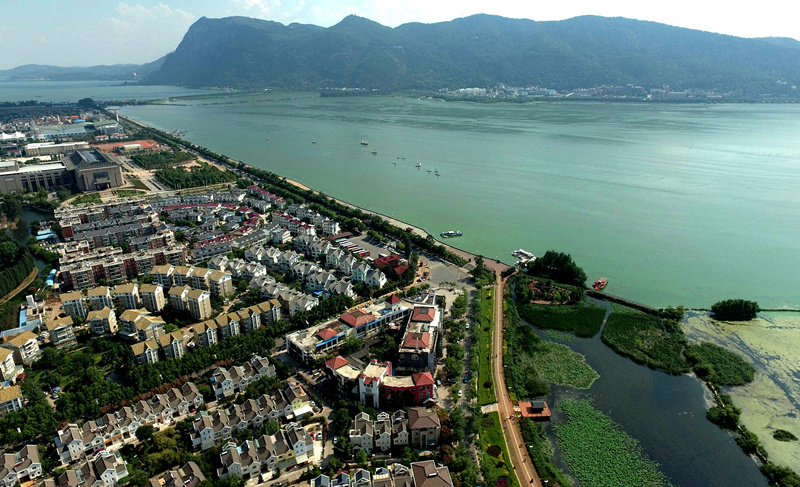
About 60 kilometers from the provincial capital of Kunming, Fuxian-with a depth of over 150 meters-is one of China's deepest plateau lakes. Kanglang once made up more than 70 percent of the fish in the lake.
Yang and his team started a project to save the species in 1990.
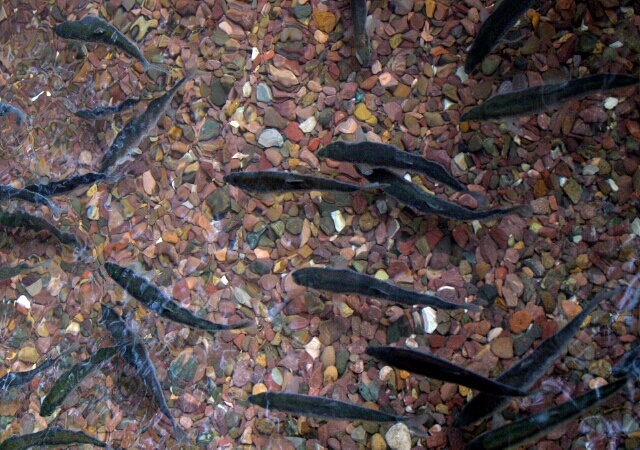
"Kanglang require a specific combination of various complicated conditions such as temperature, sunlight and water velocity for healthy breeding," he said, adding that in the beginning "failure was normal".
"All we could do was observe, think and experiment with the conditions again and again," he said.
After a year of trial and error, the captive Kanglang successfully reproduced in 1991, and the team started to release millions of fish into the lake in 1993.
"Locals saw us releasing the fish, which in their eyes meant economic profit, and they asked us about the breeding techniques and conditions. We taught them free of charge and promoted the commercialization of Kanglang around the lake," Yang said.
"Ordinary people are realistic. If they feel their livelihoods are closely related to the species, they are more actively engaged in protecting them from extinction."
The annual output of Kanglang in commercial fish farms is now about 10 tons, and at Fuxian Lake it has climbed to 8 tons. The fish are sold for around 800 yuan a kilogram-about half their price in the '90s.
"Fish farmers now invest more into breeding Kanglang, and they will never let the species die off," Yang said. "Their supply and demand determines the price, and I hope the price for Kanglang will drop to 200 yuan per kilogram because that means the output is back to a normal level."
With support from the Global Environment Facility international fund along with the local government, Yang established a 1.53-hectare breeding and research base for rare fish species in 2004.
"Yunnan has abundant biological diversity and plateau lakes. The protection of its resources is of global importance and value," Yang said, citing the GEF.
The base now has more than 80 rare species of fish, 30 of which have successfully reproduced in captivity, he said, adding that "many more endangered fish species are waiting for me to save them".






- China's Global Governance Initiative receives positive feedback at forum
- China's Xizang sees steady tourism growth in 2025
- First-of-its-kind pearl auction held utilizing Hainan FTP
- Agarwood exhibition steeps Shanghai museum in fragrance
- The Fujian Coast Guard conducts regular law enforcement patrol in the waters near Jinmen
- IP protection for new fields to improve














