


Chinese sci-fi enters pivotal new phase









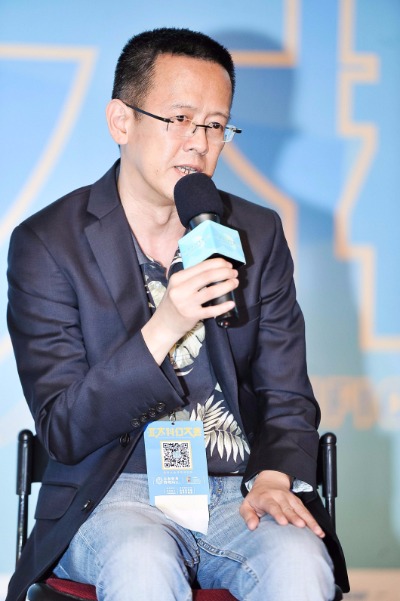
But Chinese people aspire to make great sci-fi films, Han Song says. One of the most popular sci-fi writers in the country today, Han's works have won several major Chinese sci-fi awards including the Galaxy Award and the Xingyun Award for Global Chinese Science Fiction.
Mary Shelly completed the world's first sci-fi novel, Frankenstein, in 1818. And for China, the three waves of sci-fi fever which began at the end of the Qing Dynasty (1644-1911) and ran until 2006, when Liu Cixin started serializing his The Three-Body Problem trilogy in the periodical Science Fiction World and culminated in 2010 when the trilogy was published in book form, was not only a key turning point. It also appeared to predict the coming of the fourth wave of Chinese sci-fi, which Han describes as "unprecedented".
He connects this fever, Liu's success as the first Asian author to win the Hugo Award with the economic, social and scientific advancements in China.
"Why did the books appear in 2010? It was a special turning point in China's history. It was the year when the first people born in the 1980s turned 30 years old. This generation is very different to all the previous ones. It was the year when Shanghai hosted the World Expo and China was open to the world, which I think matters more than the 2008 Beijing Olympic Games," Han says.
Economically, China overtook Japan to become the world's second-largest economy in 2010. And, in the same year, China surpassed the United States for the first time to have the biggest output value of any manufacturing country in the world.
And a year later, and for the first time in China's long history as an agricultural country, the urban population exceeded that of rural areas.
"All these mark the huge progress that China has made on its road to modernization," Han says.
Since 2010, a huge amount of money has been invested in the science-fiction industry, which has now become prosperous. And Chinese people are more determined than ever to make a really great sci-fi film like Interstellar, Han says.
"Why? Because China is the country that has the most complete manufacturing chain in the world." And sci-fi, the heavy industry of the film genre, can be seen as a symbol of the development of science and technology, especially in the cutting-edge fields such as developing space stations, car engines or microchips.
"You can see why we want to make a good sci-fi movie so much," Han says.
"Like all literary genres, sci-fi reflects reality."