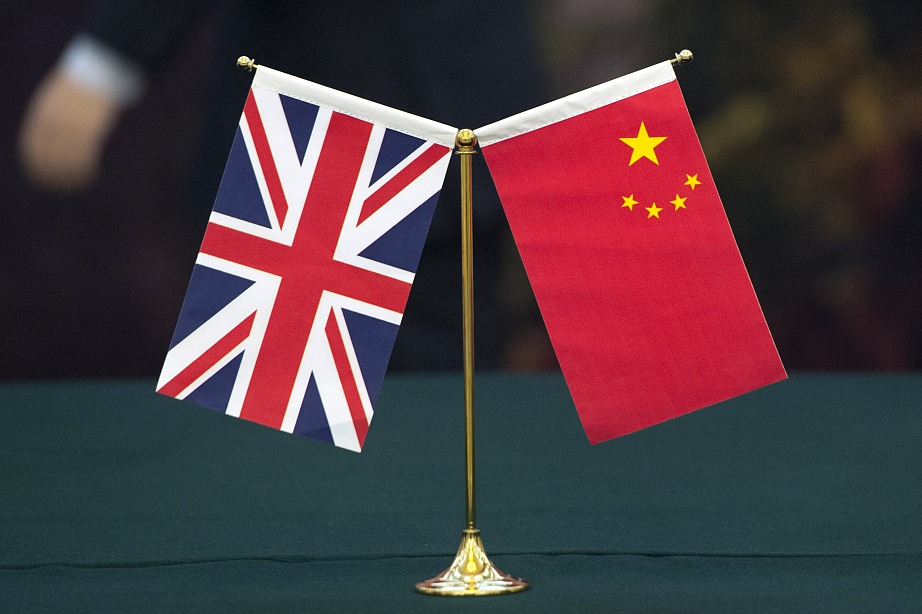
Close collaboration brings together British, Chinese cities









LONDON - Almost 8,200 km separate, Changchun in Northeast China's Jilin province and the English city of Sheffield, both described as "rust belt" areas, brought together by close collaboration between their universities.
And that closeness has helped create a home from home atmosphere for thousands of Chinese students heading to a city sitting in the foothills of the Pennines, the mountain chain known as the backbone of England.
So close is the relationship that in one university department more than a third of its students are Chinese, with one-in-10 across all faculties hailing from China.
Sheffield emerged as Britain's "Steel City" in the industrial revolution of the 19th century, but as the coal mines shut and the smelting mills fell silent, the city decided it would not just turn to rust, building instead a booming 21st century economy.
Away from the world renowned universities of Oxford, Cambridge and London, Sheffield has been winning a big slice of the action in attracting growing numbers of students from China.
CLOSE COLLABORATIOBN
This year marks the 110th anniversary of the first Chinese student to graduate from the University of Sheffield and more than a century later the one-time Steel City remains a magnate for Chinese students, attracted by a university and a city that welcomes them to their "family".
Sir Keith Burnett, vice chancellor of the University of Sheffield, who speaks Mandarin and counts Chinese culture as one of his top interests, describes one of the big tasks of the university's innovative Grantham Institute for Sustainable Futures, working in Jilin on an ambitious climate change research project.
"One of the most difficult things that's happening in China in climate change is the loss of soil, desertification," he said. "We went on a train trip from Beijing to Jilin and the thing that stuck out really is large sections of the north have actually lost an enormous amount of their soil quality, lots of devastation of farms due to a combination of climate change and other things."
"We're working with the Chinese government, particularly with one of the agencies that trains farmers and gives its community information," he added.
And back in Sheffield, the university is closely involved in an Advanced Manufacturing Park that has risen from what was once the infamous Orgreave Coking Plant. Now Orgreave is a fully integrated Industrial Research site, said Burnett, with 600 researcher doing PhDs.
"It has the national nuclear laboratory which has signed up with the Chinese nuclear power corporation," he added, "this is a university with university students doing PhDs but it's also a fully licensed nuclear manufacturing capability."
CHINESE APPROACH HAILED
Burnett's interest and knowledge in China is paying dividends for Sheffield and its university.
He said: "I have a sort of persistent theme which is that often Western people who've done a little bit of looking at China do not understand the scale of Chinese transformation. So they don't understand the scope and scale of how China has changed, and will change."
Burnett said one can see China's hope is that its people will join in with its development of a cleaner world that can feed itself.
"That's the goal, because you've got a situation in China where you want to have cleaner air, clean rivers, you want to have very environmental protection, but you want to share those with other areas in the world."
Citing the enormous investment in electric cars, Burnett agrees China will most likely be the dominant producer of electric cars in the future and maybe it will it be the domain producer of nuclear power.
"The hopes are actually to build the world based on environmentally-clean, high-technology that people can share it, particularly in areas of Africa. This is the new way to do it. China is going to go into all areas in the modern world."
Burnett said such long-term infrastructure investments could never be done in a Western economy because they don't deliver fast enough. In China, he added, what you've got is the sort of cooperation which magnificently trains its executives and the people who run it, and takes a long-term view as well.
"China is doing it with a very pragmatic corporate approach to it, with the people within it, strategic plans, incentive schemes. It's like a great big, very effective Western corporation, but with the purpose not just to make it a shareholders thing, but to make the people, China prosperous."
"It's got a whole spectrum of possibilities, and that's something that we have lost," he added.