More British international schools look to second-tier Chinese cities









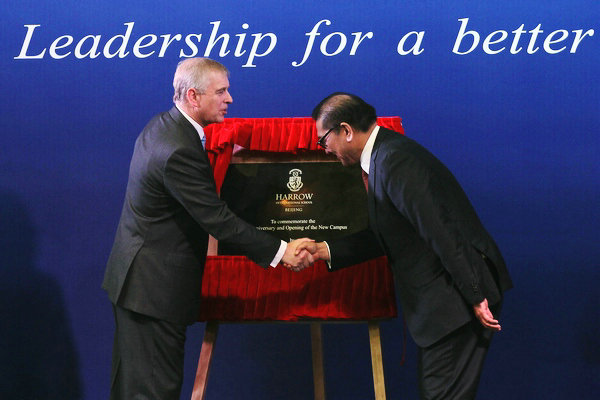
An increasing number of British schools are planning to set up campuses in second-tier cities in China, as the country's middle class expands and parents attach greater importance to their children's education.
More international schools in cities located around the Yangtze and Pearl River Deltas, in Southwest China and around Beijing are expected to open over the next few years.
"There are many opportunities within China for this type of school because the market is so big," says William Vanbergen, chairman of Wycombe Abbey International Schools Greater China.
He says that the availability of land and the livability of the city are among the most important factors when considering a location.
While "a very large piece of land, 10 hectares at least" is necessary for a school's development, Vanbergen says, the key factor lies in "where we can get foreign teachers to come and stay".
His school is going to set up campuses in Zhuhai, Guangdong province, as well as in Xiamen, Fujian province, and Chengdu, Sichuan province.
Ziver Olmez, associate director of strategic development at Harrow International School China, noted that demographics in China have changed radically over the past decade, with the middle class showing the most remarkable growth.
This group of people would like their children to receive a Western education while still retaining a good understanding of Chinese culture, tradition and language, he says.
According to the Department for International Trade (DIT) in the United Kingdom, around 10 UK independent schools have established over 25 campuses in China as of the end of last year.
Most of these campuses have been established in first-tier cities.
The number is expected to double in the coming years, with more than 20 British school brands looking to set up shops in China by the end of 2020. This would bring the total number of British campuses in the country to over 50.
Liu Jing, head of DIT Education China, said the growth of the industry can be attributed to a growing awareness among Chinese parents about education and increased government support.
"More and more Chinese parents are willing to increase the investment in their children's education and want their children to become internationally educated without forgetting about their roots," she says.
"Meanwhile, the Chinese government has issued policies to encourage investment in private schools and to regulate the development of private education."
Li Sheng, a mother of an 8-year-old boy who moved her family to the UK several years ago, says there is no rotation model in British schools, which means good teachers in those schools do not travel abroad to teach in their overseas campuses.
But studying in those international schools will make it easier for Chinese students to apply for British universities, given their reputation and the credibility of the recommendation letters they receive from teachers, she adds.