Time to safeguard global free trade









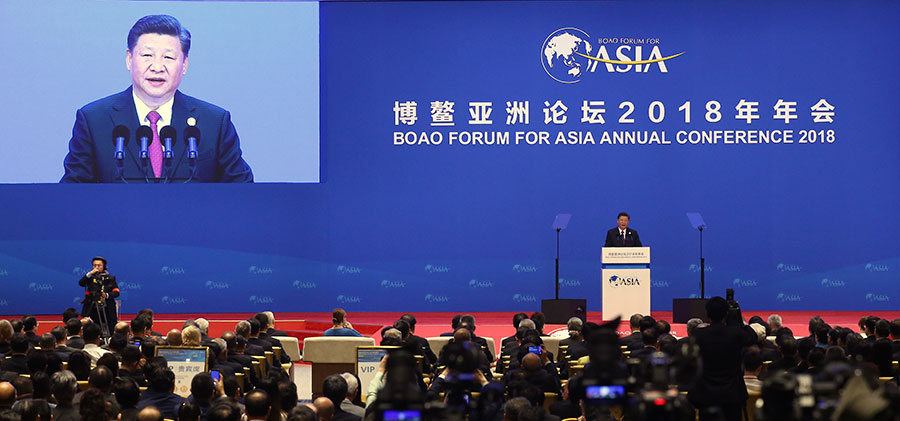
If President Xi Jinping’s speech was highly anticipated by those attending the Boao Forum For Asia, it was just as more eagerly waited in Washington and Wall Street, as trade tensions have begun to penalize US markets.
In his keynote speech, Xi urged countries to stay committed to openness, connectivity and mutual benefits, build an open global economy, and reinforce cooperation within the G20, Asia-Pacific Economic Cooperation and other multilateral frameworks, with the ultimate goal being to make economic globalization “more open, inclusive, balanced and beneficial to all.”
Xi presented plans to further open up the Chinese economy, including lower import tariffs for autos and other products, enforcement of the legal intellectual property rights of foreign firms, and improving the investment environment for international companies.
It was a balancing act that highlighted China’s goal of safeguarding the open global economy, even amid intensified trade conflicts with the Trump administration.
Over a year ago at Davos, President Xi Jinping stressed the need for global cooperation to sustain the global recovery. In a trade war, he said, “no one will emerge as a winner.”
In the White House, that wisdom got lost in translation. Now the only question is how costly that policy mistake will prove.
US President Donald Trump, who has said winning a trade war is easy, may be in for a rude awakening. The US accounts for only 15 percent of China's goods exports, and China's domestic activity – not net exports anymore – now fuels its economic growth. The US economy will carry a substantial burden, however.
Trump’s unilateral tariffs will soon begin to hit hard the constituencies that were vital for his triumph in 2016 and which remain critical to Republicans in the fall mid-term elections. Those farmers and blue-collar voters gave Trump a mandate to negotiate better terms with US trade partners, but not carte blanche, and certainly not a license to engage in a trade war.
China is the largest customer for the US’ farm surplus at over $20 billion per year. Since US farm groups have greatly benefited from the reduction of trade barriers over time, there is unease across the US heartland that Trump's tariffs could upend decades of progress. Even worse, if trade friction worsens with the US’ NAFTA and EU partners, US farmers would take hits from all directions.
As US sovereign debt now exceeds $20.7 trillion, 107 percent of GDP, and Trump’s infrastructure initiative is fueled by record-high leverage, the trade dispute is undermining critical sources of US revenue.
Trump’s trade gambit is escalating at a time when even rising interest rates can no longer ensure a strong dollar. Moreover, with $1.2 trillion of US debt, China remains the largest foreign holder of US Treasuries.
If Trump proceeds on his current course, he will not only undermine the US’ ties with China, but also with its NAFTA partners, while also alienating the US’ European Union allies and undercutting US alliances with the rest of its trade and security partners in Asia. Over time, that would undermine not just trade, but investment and finance with America’s biggest economic partners in North America, Western Europe and East Asia.
Global growth prospects are not immune to a trade war. Before Trump’s tariffs, global investment flows remained well behind their peak a decade ago. World export volumes reached a plateau already in early 2015. In finance, global cross-border capital flows have declined by a 65 percent since 2007.
While the damage of the tariffs introduced by the US so far is still reparable and reversible. The net effect of further escalation would result in critical erosion of global investment, trade, and finance. That has the potential to derail the fragile global economic recovery and disrupt international supply chains.
In that case, four decades of bilateral confidence-building could be undermined in four weeks and mistrust would soon spread to US relations with its partners in the Americas, Western Europe and East Asia.
Trump’s unilateral tariffs are on the wrong side of history.
The author is the founder of the Difference Group. He has served at the India, China and America Institute (USA), the Shanghai Institutes for International Studies (China) and the EU Center (Singapore).