


Odes to Qingming chime down years









Qingming, or Tomb Sweeping Day, is one of the most important traditional festivals in Chinese culture, and it's not surprising that this day-either the sorrows of mourning the dead, or the joys brought about by the vibrant atmosphere of springtime-inspired numerous ancient poetic souls.
Many poems related to this special day were created during the Tang (618-907) and Song (960-1279) dynasties, when the art of poetry was at its peak in China. Many of these poems have survived the test of time, and some of them have become oft-quoted and widely beloved.
If you ask any Chinese person about poetry related to the day, they are most likely to cite the famous ode written by the ninth-century poet Du Mu. His short piece, simply titled Qingming, provides a perfect description of the festival's typical mood.
"A drizzling rain falls like tears on Mourning Day. The mourner's heart is breaking on his way. Where can a wine house be found to drown his sadness? A cowherd points to Apricot Flower (Xing Hua) Village in the distance."
Believed by historians to have originated over 2,500 years ago, Qingming Day is traditionally a time to remember and honor ancestors, and is a sign that family values still play an important part in Chinese culture.
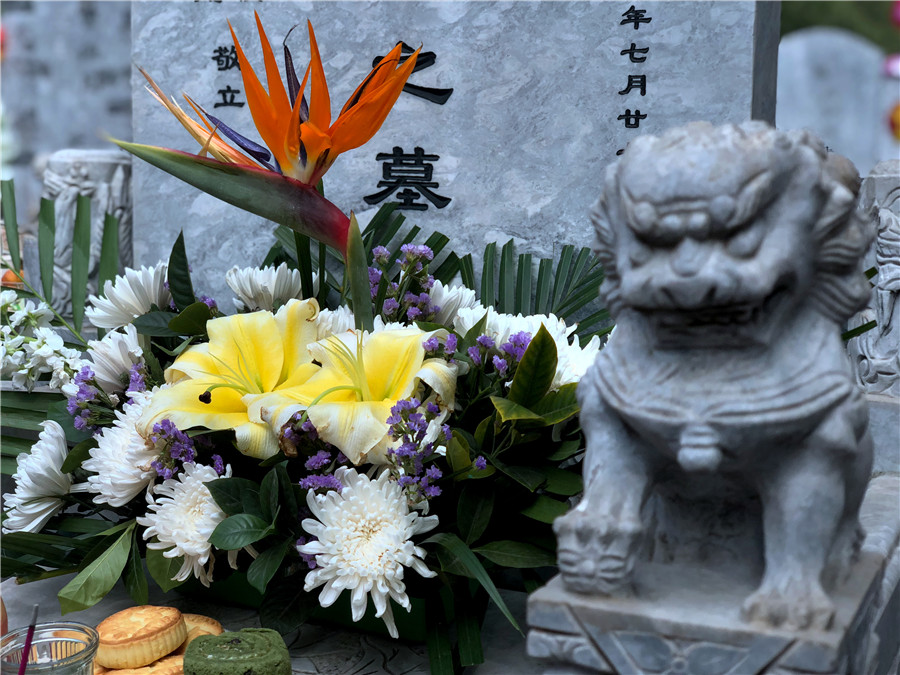
On this day, families bring flowers, food and alcohol to the graves of their ancestors. Some burn joss paper for the dead. Afterward, they sweep the tombs and cherish the memories of their departed family members.
In fact, Du's poem Qingming had become so well-known that the name "Xinghua Village" mentioned in his poem has gradually come to symbolize a refuge, or simply a place that sells good booze. Today, there are more than 30 places in China that bear the name.
Another poem by Song poet Gao Zhu that is also titled Qingming deals more directly with the tomb-sweeping scene: "Many graveyards on hilltops, where people are all busy sacrificing and renovating the tombs. There the ashes from burnt joss papers are flying as white butterflies, and the azaleas are so red as if dyed with the tears and blood of the heartbroken."
For those who found themselves far from home, the occasion of Qingming must have been a hard time because it often evoked feelings of sentimentality or homesickness in verse.
Many poems were dedicated to these sentiments, such as the piece named Written on the Day After Qingming in Yiyang by the Tang poet Quan Deyu.
"I sigh silently because I am so far away from home during Qingming Day. The long Gexi River in my hometown should be covered with fallen tung blossoms now, and I imagine my family must be holding the newlyset fire, only to light up the lonely lamp in an empty room."
While Qingming has been frequently mentioned in Chinese literature, it is not always associated with the heavy mood of the day.
The season is also when Chinese people enjoy gardening and outdoor activities, and families often gather together to go on outing.
Clues about this phenomenon can be found in many other poems.
A short poem by the Song poet Wu Weixin, which is titled Qingming Scene on Su Causeway on West Lake, reads: "The pear blossoms are dancing in the wind, and here comes the Qingming Day. Almost half of the young people were out of town to enjoy spring. The playing and singing finally came to an end at dusk. And warblers flying about now reclaim the numerous lakeside willow trees."
The piece vividly describes the spring scene at the famous West Lake in Hangzhou, Zhejiang province, and the popularity of outings during the festival then.
Historians found that the tradition for outings during Qingming started in the Tang Dynasty and became very popular in the Song era.
Besides outings, there were many traditional activities related to Qingming, such as playing on swings, playing cuju-an ancient Chinese style of soccer-and tree planting.
According to Wang Wei, the deputy director of the Academy of Chinese Studies, ancient poetry is closely connected to, and an important element of, traditional Chinese days of observance like Qingming.
"Through studying these poems, we can better understand and inherit these traditions in modern times."