



NGOs innovate to fill healthcare gap









Unexpected gifts
According to Wang, the clinic was first set up in 2015 in the hope that doctors with expertise would continue to make contributions after their retirements. Data showed that around 65,000 specialists retired at age 60-which is a great waste, he said.
"It's like they've been climbing the Himalayas all their lives and when they almost reach the peak they are told they are out of the game," he said, adding that retired doctors between 60 and 75 are mostly still able and willing to work.
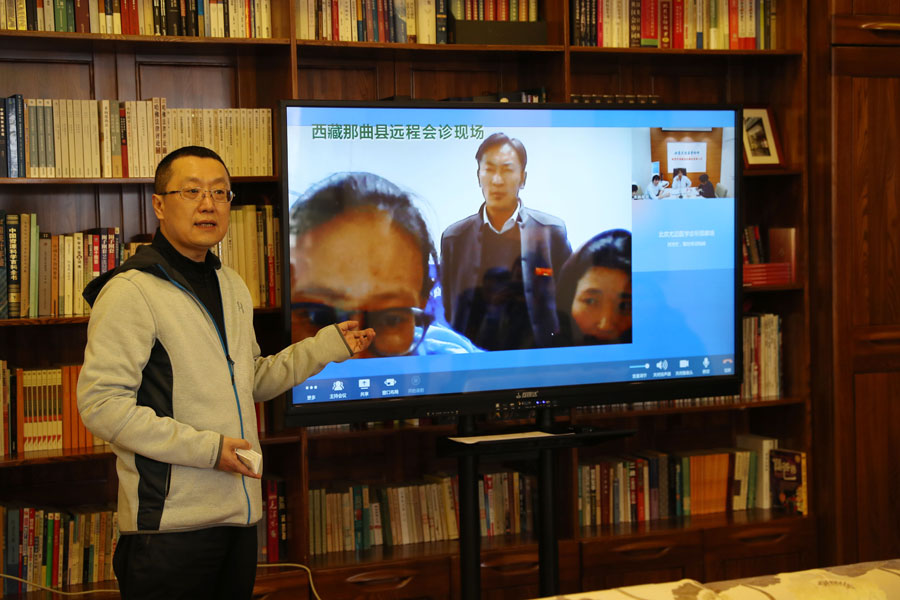
Wang later found that accurate medical diagnoses and optimal treatment plans given by retired specialists, when combined with WeChat video calls, could be utilized to combat poverty in remote regions. Dai Jinjin, the clinic's director, said long-distance treatment requires nothing more than a computer, a microphone and a camera.
"Since most of the patients have had multiple checks beforehand, what happens during the video call is that local doctors present the test results to Beijing doctors and explain the patient's medical history," she said.
The foundation gives 100 to 600 yuan to local doctors for every consultation to encourage them to participate in the project.
The clinic first tried out the approach in August at People's Hospital of Tailai county, Heilongjiang province. But soon it found that the long-distance treatments also became a demonstration class for grassroots doctors. Now it has partnered with some 30 hospitals in 21 provinces and regions to help with poverty reduction.
Innovative payment
The retired specialists at the clinic are not volunteers. Wang said that asking retired doctors to give free consultations would be neither sustainable nor desirable. "Quality medical resources come at a price, but we are innovating with charity products to get the bills paid," he said.
According to Wang, the total cost for a 30-minute consultation is 3,000 yuan, which is used to pay the doctors and the other support personnel. Currently the cost for more than 200 beneficiaries of the clinic's poverty relief project-roughly 600,000 yuan-was first paid by Beijing Union Charity Foundation, he said.
Wang said the foundation plans to employ more retired doctors and finance up to 10,000 consultations by the end of the year, with an expenditure of 30 million yuan. He will then divide the consultation costs into packages of 300,000 yuan and sell them to enterprises and philanthropists who are willing to contribute their share to the poverty reduction campaign.
"Many people want to donate money but cannot find a trustworthy program. To make sure donors are reassured and willing to donate, we pay the money first and then produce the list of patients who have received the treatment," he said.
Problems
Though confident about the project's prospects, the clinic's managers were candid about the difficulties ahead.
Dai, the clinic's director, said the language barrier is one problem. "Patients from remote regions usually have strong accents or use their own dialects, which creates an obstacle for effective communication," she said.
Wang said that when seeking partnerships with local hospitals, "they are suspicious about our motives, which I totally understand. Some are worried that Beijing experts embarrassing their doctors in front of patients would damage their image and lead to a decline in revenue".
Wang Yali, chief physician at No 3 Hospital of Datong, Shanxi province, and a deputy to the 13th National People's Congress, said the model the clinic has used to help alleviate poverty can be replicated to help to share the best medical resources in China and let more people benefit.
"The project mainly focuses on the rural poor. In my hospital, there are several cases every month that our own doctors cannot handle. If the clinic can build a channel for consultation for all patients, more would benefit," she said.
Zhao Wanping, another NPC deputy, said the unbalanced distribution of medical resources has long been a problem, which has led to congested hospitals in big cities such as Beijing.
"The clinic's approach provides a potential solution. But the actual effect of long-distance medical consultation remains to be seen," he said. "Some diseases need more complex examinations than can be provided by a video call and medical history."
Li Shun contributed to this story.


- Books of Xi's works on economy, recounting his interactions with university students debut in Hong Kong
- Study reveals endophytic fungi fermentation enhances coffee flavor
- Xi meets National Leader of the Turkmen People and Chairman of the Halk Maslahaty of Turkmenistan
- Herdsmen in Inner Mongolia busy with lamb breeding
- Japanese politicians hype up China's defense budget to justify Japan's hidden military expansion ambitions, says PLA spokesman
- Chinese scientists adopt magnetic fluids to treat heart disease





