NPC and Standing Committee have key responsibilities









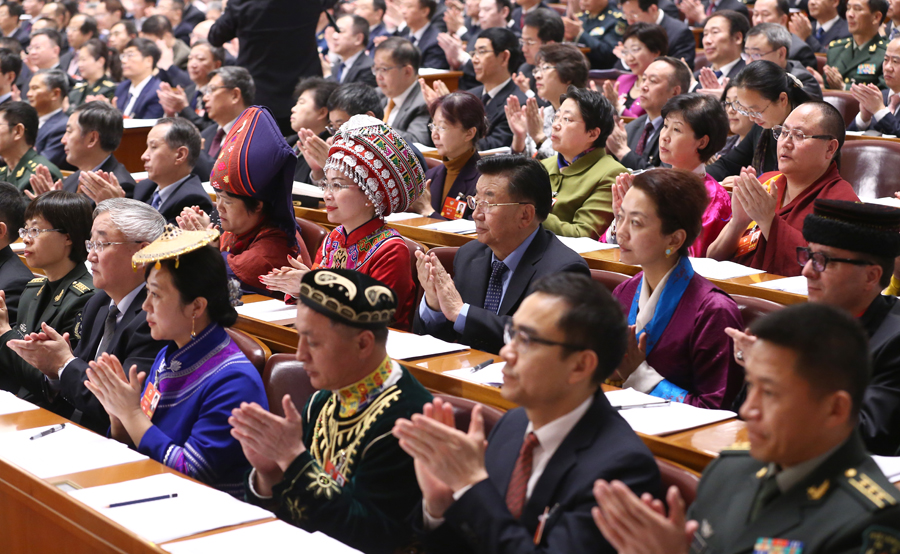
All of the deputies to the 13th National People's Congress-2,980-h(huán)ave arrived in Beijing for the top legislature's first plenary session, which starts on Monday.
The deputies, who are responsible to the people and subject to their oversight, will review a number of key reports, such as the annual work reports of the central government, the NPC Standing Committee, the top court and the top procuratorate, as well as the national fiscal budget.
This year, they will also deliberate on a draft amendment to the Constitution and the draft national supervision law, according to an agenda released earlier.
The State Council, the Supreme People's Court and the Supreme People's Procuratorate are under the supervision of the NPC, to which they deliver work reports.
As the top legislative body, the NPC, which holds its plenary session once a year, exercises the power to make and revise laws. When it is not in session, the NPC Standing Committee, the permanent body of the NPC, will partially supplement and take charge of introducing and amending laws.
For example, the 12th NPC Standing Committee has introduced 25 laws in the past five years, increasing efforts in making laws on State security, environmental protection and cultural developments.
Since 2012, a series of laws relating to State security have been unveiled, such as the National Security Law and the Cybersecurity Law, basically forming the country's legal framework on security.
The NPC Standing Committee is composed of a chairman, several vice-chairs, the secretary-general and other members.
All of them are elected from deputies for a term of five years, the same term as the NPC.
The committee normally meets once every two months, but it may hold interim meetings if there are special circumstances.
Besides legislative power, the committee also is given the power to supervise, decide on major State issues, and appoint members of State organs and remove them from office when the NPC is not in session.
It has the power not only to oversee the enforcement of laws, but also to ensure that administrative rules and judicial interpretations made by other authorities are in line with laws.




- Pick your own cherished flowers in downtown Shanghai
- Liangjiang New Area of Chongqing inaugurated
- 17 rescued Filipino crew members transferred
- Team of Chinese, US scientists identifies key tumor cell state driving cancer growth, drug resistance
- China conducts first metal 3D printing experiment in space
- Debt-ridden children's hospital gains strong public support, but future still uncertain