



The preposterous 'evidence' that casts Chinese students as spies









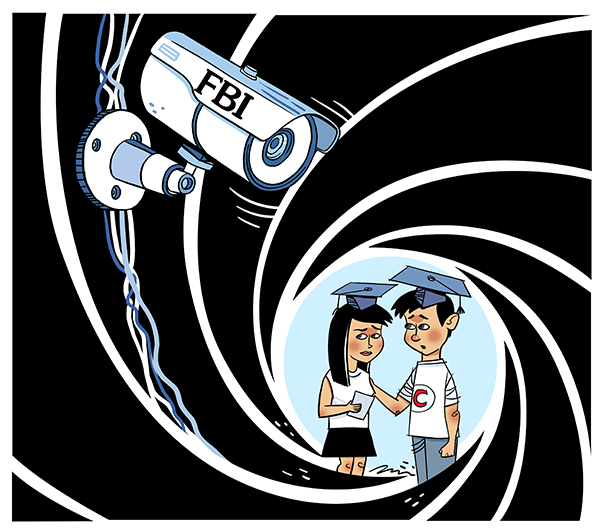
Following a school shooting in Florida that killed 17 people, including that of a Chinese-American student who held a door to let his classmates escape, we learned that the FBI received a tip about the shooter last month but failed to act.
The FBI might be busy with other threats, such as Chinese students who could be spies. In a piece titled "The Chinese Student Threat?" (Feb 15), Inside Higher Ed reported that FBI Director Christopher Wray told a Senate panel that American academe is "na?ve about the intelligence risks posed by Chinese students and scholars".
On Jan 3, Inside Higher Ed published another piece promoting a red scare. In the article titled "China's 'Long Arm'", evidence of spying according to the author is that Professor Kevin Carrico discovered twice, in his six years of teaching, that something he taught in class about sensitive topics was reported in China and then back to him. Therefore, there could be spies in his class.
This professor probably should know that Chinese students, like their American peers who use Snapchat, probably post such things in their WeChat moments or WeChat friend circles.
To believe there is espionage involved in such activity shows the extent of the teacher's self-importance, which could have been a treatable condition if he had not been so distrustful of his own students.
China has its share of issues, but why would anyone be interested in him bringing his lesson in line with a Chinese narrative? What does anyone in China have to gain in doing that?
Another piece of "evidence" came from University of Maryland student Shuping Yang, who made a speech praising the "fresh air" in America. Yang's speech was heavily criticized in China.
I witnessed the whole process of Chinese social media reaction about the event. If the author suspected that there is "long arm" behind this, she would have been gravely mistaken.
When the speech was publicized, Chinese netizens showed disapproval much the same way a middle school student dislikes a classmate kissing up to his teacher. To find some conspiracy of government backing in this fiasco is to tilt at windmills.
If in an American classroom a teacher hears a Chinese student expressing different views about Tibet or Taiwan, you are under no obligation to change what you believe in.
In the meantime, it is probably better to hear what these students have to say rather than defaulting to suspecting that their different opinions should be attributed to spying or brainwashing. You cannot tell about freedom of speech and then show you stifle dissenting views in the classroom. Practice what you preach.
It is no secret that countries compete. However, to paint with a broad brush an entire Chinese student and scholar group hurts not only innocent Chinese on American campuses, but also American higher education.
The Inside Higher Ed article said spying is "across basically every discipline". That would include business, design, history, ESL, music, film, art history, education, physical therapy, conflict resolution and biblical studies.
Would an education major pose security risks by talking about Bloom's taxonomy, Robert Gagne's conditions of learning, or John Dewey's philosophy of pragmatism? Would it hurt if a Chinese scholar were to study Eugene O'Neill, Emily Dickinson or Henry James?
Promoting xenophobia is the last thing higher education needs now, and such sentiments kill intellectual freedom and diversity. It is a new form of anti-intellectualism whose logic would make it desirable to ban all cultural exchange with any potential of benefiting another country.
Such hateful attitudes also hurt America's national interest. American ideals and beliefs are seldom abstract; they are embedded in knowledge, skills and attitudes taught in different disciplines.
If there is concern that some students pose national threats in certain disciplines, those issuing visas or processing background checks should play a more active gatekeeping role.
The rhetoric of threat everywhere on campuses creates a culture of suspicion in the classroom, placing the burden upon universities and professors who would not know what to do except perhaps turn distrustful in their teaching.
It will alienate Chinese students and scholars. University classrooms are better positioned to be hospitable places to pass on knowledge, promote goodwill and facilitate mutually beneficial exchanges of ideas.
Just because this is the Year of the Dog does not mean one should bark up the wrong tree by bringing suspicion upon all Chinese students and scholars.
The author is a US-based instructional designer, literary translator and columnist writing on cross-cultural issues.





