Clearer regulations on digital hongbao needed









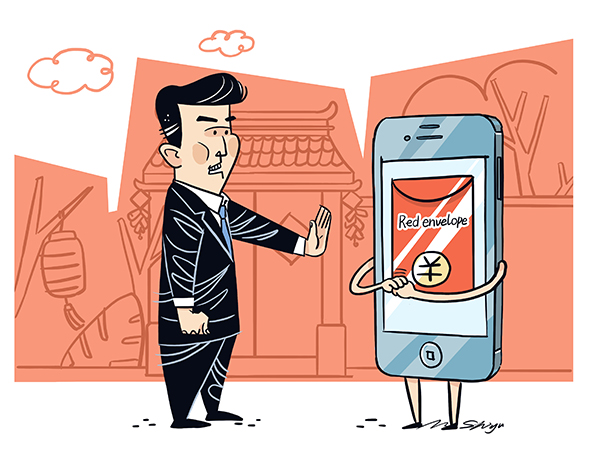
This Lunar New Year, the Central Commission for Discipline Inspection has once again stressed members of the Communist Party of China must obey the Eight-Point Regulation, which aims to curb corruption and extravagance. Festivals and holidays used to be peak periods for such extravagance and gift-giving in exchange for favors. But over the last five years, thanks to the enforcement of the code of behavior for officials, expensive banquets paid for with public money have largely disappeared during the holidays.
However, with the rise of digital payment services, sending and receiving gift money during festival has come to the fore.
The sending and receiving of hongbao among relatives and friends to promote or maintain their relationships, especially during Spring Festival, is a longstanding tradition. In many areas in China, elders traditionally give money in red envelopes to children during the Spring Festival as a Lunar New Year gift, and many friends will also give red envelopes to one another to celebrate the festival.
Such a tradition entered the digital domain in 2014 when WeChat, the popular instant-messaging app operated by Tencent, introduced digital "red envelopes" allowing users to send each other monetary gifts via the app.
WeChat "red envelopes" and other digital money transfer services such as Alibaba's Alipay have been a big success, as they are a convenient way to give hongbao during the festival. However, such digital red envelopes were also considered a covet way to give or receive bribes.
Digital hongbao are a quick and easy way to exchange money from one person to other, and they quickly drew the attention of corrupt officials. This in turn attracted the attention of the anti-graft department, which has repeatedly cautioned officials not to accept envelopes or other types of gifts through the Internet.
In May last year, the discipline watchdog in Hi-Tech Industrial Development Zone of Chengdu, capital of Sichuan province, punished 19 people for receiving digital hongbao via WeChat. And the Wechat money transfer record was accepted as evidence by the court.
The case should be a cautionary tale to those who want to take advantage of new digital money transfer services for bribery as they are not "without trace" as some might wishfully believe.
But there is another, trickier aspect to their use of digital hongbao.
A controversial example is that a primary school teacher in Lianzhou, Guandong province, who recently received a Wechat "red pocket" with 88.88 yuan from one of her student's parent, and immediately sent back a Wechat "red pocket" to the parent containing 90 yuan as it is common practice to give more than is received. The parent didn't accept the red envelope sent by the teacher, and instead reported her to the local education authority, because the teacher had sat the child, who is tall, near the back of the class. The teacher received disciplinary punishment.
She claimed she didn't intend to receive money from the student's parents and was afraid of hurting the parent's feelings if she refused the red envelope. And she sent one back because of the accepted principle that "courtesy demands reciprocity".
Curbing "holiday corruption" is highly welcomed by the public, but detailed regulations on the amount of gift money that can be sent and received in digital hongbao is necessary, which will not only help effectively fight against corruption, but also respect normal festival conventions. Tighter regulations are also needed to ensure that not only digital hongbao cannot be used to give and receive bribes but also to ensure that they cannot be used as a means of revenge for those with a perceived injustice.
The author is a writer with China Daily.