Spring Festival travel mirrors China's changes over 40 years









BEIJING - Although the term Chunyun (Spring Festival travel period), first appeared in Chinese news media in 1954, it did not become a phenomenon until 1979 when a record high of 100 million trips was made for the first time.
At the time, Chinese people only had Sunday off each week, and there were no golden weeks such as the May Day and National Day holidays. Spring Festival was the only long vacation that the Chinese could use for travel.
But low salaries under the planned economy constrained people's travel demands. Few people could afford to travel, and there was no significant rise in the number of trips made during Spring Festival.
After the economic reform and opening-up policies were adopted in 1978, not only did people earn more, but productive resources, including human resources, began to flow across the country due to market forces.
Surplus rural workers entered cities to make a living while urbanites in smaller cities went to large cities for higher pay and better careers.
This year, the total passenger traffic during the 40-day-long Spring Festival travel ending March 12 is expected to reach 2.98 billion, nearly 30 times more than in 1979.
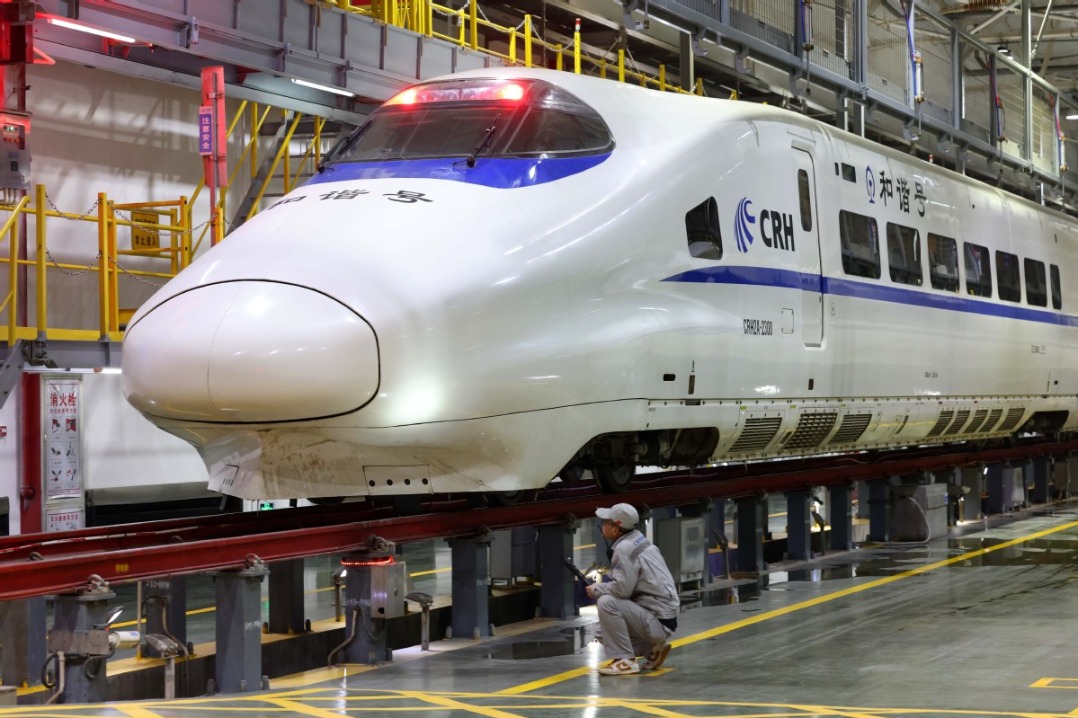
Another change relates to speed. In 40 years, the operational speed of Chinese railways has surged from less than 40 km per hour to up to 350 km per hour.
From Beijing to Shanghai 1,300 km away, it used to take passengers 24 hours. Now, the travel time has been cut to 4 hours.
Huang Xin, deputy director of the Passenger Transport Department of China Railways Corporation, previously worked with the Guangzhou Railway Group.
He said that 20 years ago, the queue for ticket booths at Guangzhou Railway Station usually extended for several kilometers. It was normal for people to queue overnight.
Now people can book tickets via telephone hotlines or buy e-tickets through an official website. Given the strong travel demand, however, it is still not easy to get a ticket.
According to Zhu Jiansheng, deputy chief of the Institute of Computing Technology under the China Academy of Railway Sciences, the average daily pageviews of the 12306 ticket-booking website was 55.67 billion.
At peak times, the number was as much as 81.34 billion, with the highest pageviews at 6 billion per hour.
Each day, 15 million tickets were sold by the website, he said.
Nevertheless, long queues at railway stations have been eased, as more than 60 percent of tickets are purchased online.
High-speed railway stations are more like airports, complete with catering facilities where passengers can wait for their trains with a cup of coffee in hand.
Back in 1978, facilities at railway stations could only meet transport needs. Snack counters were scarce.
Forty years ago, the railway was known as the "big brother" of the transport industry because of its predominant position in freight and travel.
China did not have any expressways until the first of its kind was built in 1988, linking Shanghai and Jiading.
As the country's highway intensity, measured by the highway mileage within 100 square kilometers, has increased from 9.1 km to 48.92 km since 1978, China now has a dense road network.
Last year, the total mileage of expressways reached 136,000 km, covering 97 percent of cities with a population larger than 200,000 each.
Road trips are expected to take up more than 80 percent of trips made during this year's Spring Festival, which begins on Feb. 15, with railway trips at about 400 million, taking up only 14 percent.




- Agarwood exhibition steeps Shanghai museum in fragrance
- The Fujian Coast Guard conducts regular law enforcement patrol in the waters near Jinmen
- IP protection for new fields to improve
- Draft rules define premade dishes in consumer interest
- Self-powering pacemaker could last a lifetime
- China intensifies crackdown on misuse of personal data