Inter-Korean talks alone can't resolve issue









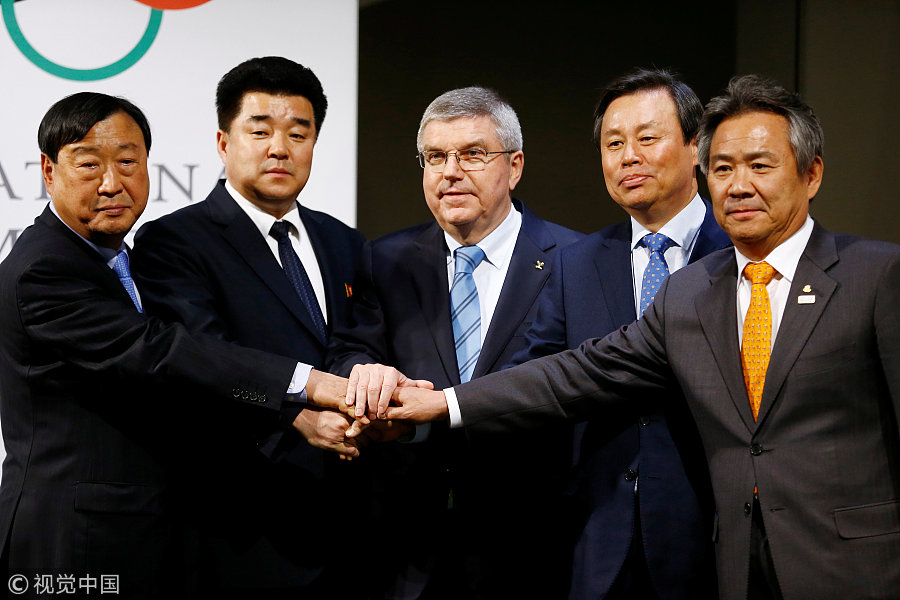
The Democratic People's Republic of Korea and the Republic of Korea have restored communication and organized several joint activities before the Feb 9-25 Winter Olympic Games in Pyeongchang, the ROK, easing the tensions on the Korean Peninsula caused by Pyongyang's nuclear and missile tests.
But will this peace last long? Seoul and Pyongyang have attached importance to the talks before and during the Winter Olympics for different reasons. Pyongyang is seeking to deflect the extreme pressure created by the sanctions imposed by the United Nations and the United States, and the latter's belligerent attitude. And it realized that improving ties with Seoul might do the job.
For the ROK, its President Moon Jae-in has been willing to improve Seoul-Pyongyang ties. But the conservatives in the ROK suspect the DPRK is taking advantage of Seoul, which makes sense, because on Jan 23 Pyongyang announced that it had changed its Army Building Day from April 25 to Feb 8, the day before the opening ceremony of the Pyeongchang Winter Games. This was followed by the Pyongyang-based Korean Central News Agency saying a large-scale military parade would be held this year to mark the 70th anniversary of the DPRK's Army Building Day.
Besides, late on Jan 29, the DPRK abruptly cancelled an inter-Korean cultural event, to be held at Mount Kumgang in the DPRK on Feb 4, saying the move was in response to the ROK media questioning its commitment to Seoul-Pyongyang talks.
In fact, the cancellation of the joint event might be one of Pyongyang's attempts to seize the initiative on the Korean Peninsula issue, which it hopes will prompt Washington to hold direct talks with it.
In the long run, however, inter-Korean ties may hit a roadblock, as disputes between Seoul and Pyongyang are very complicated and thus cannot be resolved in a short time. Given the differences in the understanding of the DPRK and the ROK when it comes to "Olympics diplomacy", the sports-centered inter-Korean talks may not help improve bilateral political and economic ties even if the communication continues after the Winter Games.
More importantly, the improvement in Pyongyang-Seoul ties is no guarantee that relations between Pyongyang and Washington, too, will improve.
There is a global consensus that the DPRK's nuclear and missile tests are detrimental to international security. And Pyongyang is not likely to abandon its nuclear program, because the DPRK considers it a strong deterrent against the US as well as a means to force the US to the negotiation table. Plus, US President Donald Trump and DPRK leader Kim Jong-un have exchanged personal insults and used confrontational rhetoric.
And even though the US and the ROK have deferred this month's joint military drills, which Pyongyang regards as a threat, to make ROK-DPRK talks possible before the Winter Games, the joint US-ROK-Japan military exercises will be held every year as part of a cooperation mechanism for the trilateral alliance.
Washington has always been reluctant to hold direct talks with Pyongyang. But when the DPRK claimed on Nov 29 that its "Hwasong-15" intercontinental ballistic missile was capable of hitting the US mainland, the Trump administration intensified its military threat against the DPRK.
The conflict of interest between the US and the DPRK will continue after the Winter Games, and Seoul, despite endeavoring to restore peace on the peninsula and promoting US-DPRK talks, will, in the ultimate analysis, side with Washington.
For now, the international community should value the temporary peace on the Korean Peninsula and persuade Washington and Pyongyang back to the negotiation table. It is thus surprising that China and Russia, which have close relations with the DPRK, were excluded from a meeting on the peninsula issue in Vancouver, Canada, on Jan 16, although foreign ministers from 20 countries were invited. It's time the West set ideological differences aside and realized the importance of working together to denuclearize the peninsula.
The author is head of the Institute of International Politics at the Northeast Asian Studies College, Jilin University.