



GDP alone can't measure quality growth









High-quality economic growth is an important element of "Xi Jinping Thought on Socialist Economy with Chinese Characteristics for a New Era". As socialism with Chinese characteristics has stepped into a new era, so has China's economic development, transitioning from high-speed growth to high-quality growth, which in turn will lead to a series of drastic changes including those in the development model and evaluation index.
It is important to remember that there is a difference between economic development and economic growth. The latter refers simply to GDP growth, while the former means all-round economic growth, development and improvement. High-quality economic development thus includes higher product quality and industrial level, and better industrial distribution and product structure.
Scientific, effective and reasonable resource distribution is necessary to build a modern industrial structure and harmonious society, and to make economic development balanced enough to meet "people's ever-growing needs for a better life". In this sense, high-quality development refers to comprehensive improvement in economic, social and natural parameters. High-quality development based on total factor productivity and innovation is what sustainability all about.
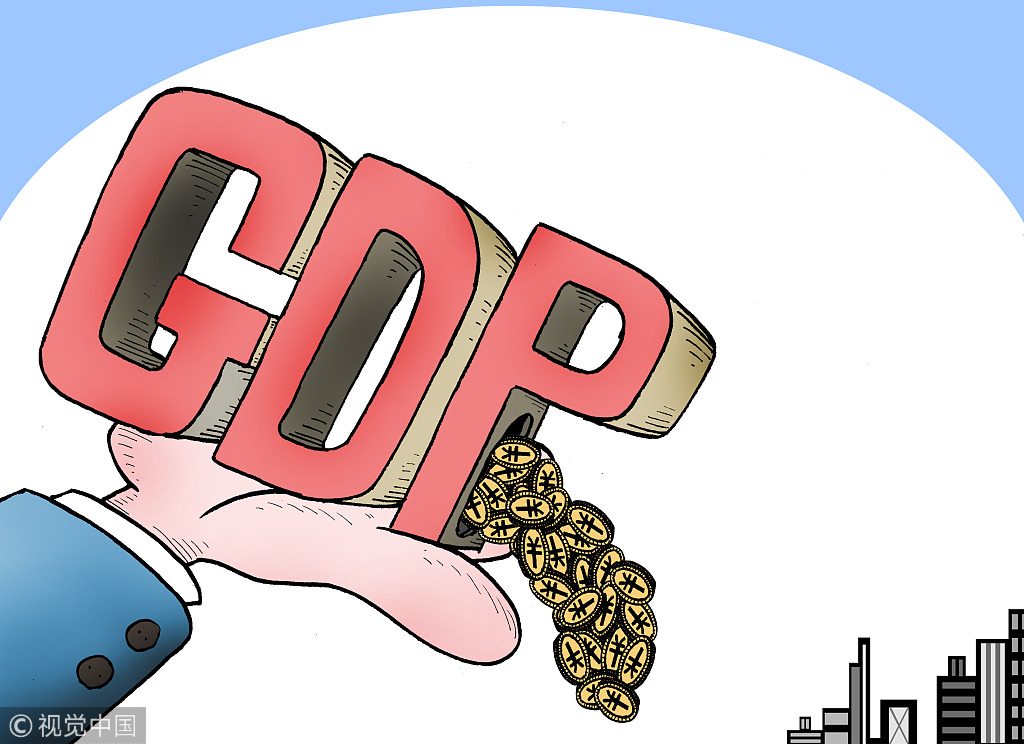
But high-quality development cannot be measured by GDP growth alone. In some cases, pursuing fast-paced GPD growth, the core indicator of economic growth, could be detrimental to quality economic development. Gross domestic product is an absolute economic quantity concept, first developed by US economist Simon Kuznets in 1934. It is a monetary measure of all final goods and services of a country in a given period (quarterly or yearly) of time. It is especially applicable to economies such as the United States, where all the products are included in transactions.
With the rising polarization between the rich and poor, and worsening environmental pollution, more and more people want a different criterion to be used to measure social and economic development. And some economists have proposed criteria such as "happiness index" and "human development index" as an alternative.
GDP has many shortcomings in terms of evaluating economic development. For instance, it ignores the importance of self-sufficiency. If one woman is employed by a man to do housework, GDP will increase accordingly. But if the man marries a woman and she does the same work as the housemaid, albeit without getting paid for it, GDP will reduce. Take another example. Sales of air purifiers increase when air pollution levels are very high, which increases GDP but not necessarily people's welfare. Or, when a serious road accident damages a car beyond repair, and its owner, who is seriously injured, decides to buy a new car, GDP will increase, even though the car owner will suffer a loss.
GDP also hides the debt situation, as a region with high GDP may be supported by high debts, which actually carry tremendous financial risks. As such, traditional growth models that yield rapid economic growth may also cause unbalanced, inadequate development, which can hardly satisfy people's high-end demands. And if GDP is considered the main criterion for evaluating officials' political performance, the officials are quite likely to fudge the GDP figures.
Fast-paced, high-volume GDP growth has made China the second-largest economy, but it has also created a lot of problems, including high environmental pollution, serious structural headaches and financial risks. All these suggest GDP should not be used as the main index to evaluate quality economic development.
China's economic development has entered a new era. The transition from high-speed growth to high-quality growth is a difficult but historic process. And global experiences show achieving high-quality development is much more difficult than high-speed growth.
Therefore, we should first make more efforts to accelerate the transition process and be prudent about economic stimulation. Second, we need to intensify research to determine the best indicator for high-quality development according to the five development principles contained in "Xi Jinping Thought on Socialist Economy with Chinese Characteristics for a New Era". And third, we have to create an innovation-friendly environment, in order to improve the quality of economic development.
The author is a professor of economics at Renmin University of China.





