



Yunnan Observatories detects echo from moon reflector









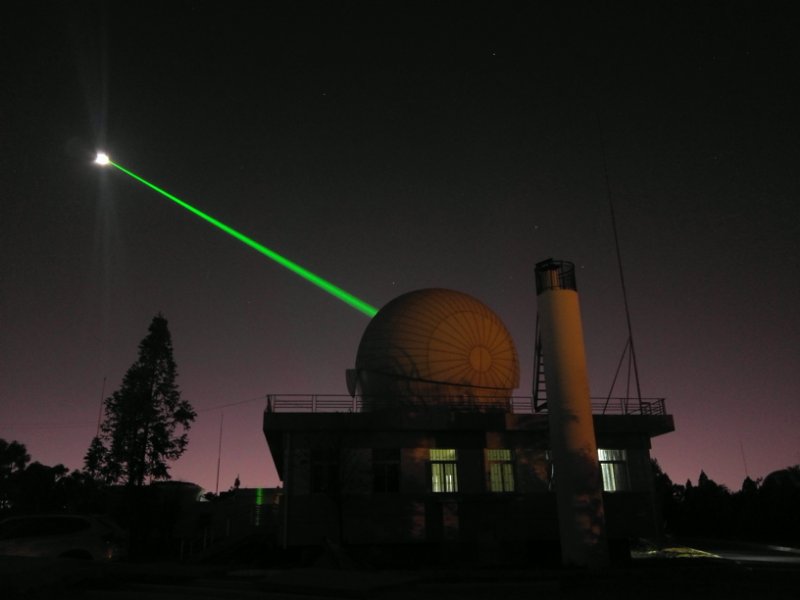
The Applied Astronomy Group of Yunnan Observatories, Chinese Academy of Sciences detected the laser echo signal from the lunar-surface reflector Apollo 15 for several times, which is the first successful LLR experiment nationwide in China.
On the night of Jan 22, using the 1.2-meter Telescope Laser Ranging System, the group detected the laser echo signal from the lunar-surface reflector.
LLR is to calculate the distance between the Earth and the Moon precisely, by measuring the time of the laser pulse traveling from ground station to the lunar reflector. It is a comprehensive technology covering a number of areas from laser, photoelectric detection, automatic control to space orbit, which is also currently the most accurate technique in Earth-Moon distance measurement.
The observational data has significant value for many areas such as astronomical geodynamics, Earth-Moon dynamics, lunar physics and the verification of gravitational theory. Previously, there were only three countries, including the US, France and Italy, which succeeded in LLR experiment. This time the lunar ranging carried out by Yunnan Observatories fills the gap in Chinese LLR area.
The 1.2m Telescope Laser Ranging System uses common optical path mode. The laser wavelength is 532nm with pulse-width 10ns and frequency 10Hz. Laser energy during the experiment is 3.3J. Average Earth-Moon distance is 384403.0km. From 21:25 to 22:31, as shown by the experimental data, the distance between the observatory and the lunar reflector Apollo 15 is 385823.433km~387119.600km, with ranging accuracy within 1 meter.


- Seven dead, 12 hurt as vehicle rolls over in Yunnan
- Purple sea of?catnip flowers?blooms in Shandong town
- 'Blue tears' turn Fuzhou's beaches fluorescent
- China-made marine-derived antitumor drug to begin combination therapy trials soon
- Wild apple trees create a poetic spring landscape in Xinjiang
- Tianjin town plays leading role in global instrument trade





