Remedying age-old gender restrictions









 In an industry once dominated by men, a female medic wears many hats, and shoes
Tashi Tso has to change into three different pairs of shoes a day - high heels before entering the office, canvas shoes at work, and white rubber soles in the manufacturing room.
She works at the pharmaceutical department of the Tibetan Medicine Hospital in Xining, capital of Qinghai province, and the shoe changes are necessary to meet national hygiene standards.
"I love my job and am thrilled to be in an industry that was once dominated by men," she said.
For thousands of years, Tibetan medicine traditions were passed down in monasteries, and the best doctors were often monks. Women rarely had the chance to learn the trade, and their roles were generally restricted to household chores and raising children.
As one of China's most influential scientific disciplines, Tibetan medicine has been used to cure aches and ailments for over 3,800 years. It draws on traditional Chinese, Indian and Arab remedies, and uses herbs, minerals and sometimes insects and animal parts.
China has intensified measures to support the development of Tibetan medicine. An innovation platform promoting its remedies was recently jointly established by medical experts from Beijing, the Tibet autonomous region, Gansu and Qinghai provinces.
In Qinghai, home to many ethnic Tibetans, a program supporting the development of Tibetan medicine was also launched last month.
Fifteen therapies and practices have been given national intangible cultural heritage status, and the output of these medicinal products reached 2,300 metric tons, valued at 1.5 billion yuan ($234 million), in 2016.
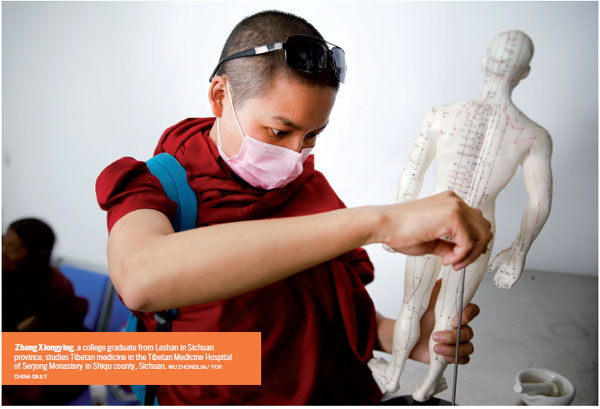
Due to government support and the rapid development of Tibetan medicine, women are gradually breaking through the glass ceiling in a male-dominated field.
Women make up half of the physicians at the Tibetan Hospital in Lhasa, the capital of Tibet. Among the graduates of Qinghai University's School of Tibetan Medicine each year, half are women, according to Tencho, an employee at the university.
Now, both men and women can learn Tibetan medicine at colleges in Qinghai, Tibet, Gansu and Sichuan.
"Women are more patient and careful in the manufacturing process, such as making pills, pulverizing and quality control," Tashi Tso said. "Of the 51 medical workers in my department, 26 are female."
Tashi Tso was among the first group of students enrolled at Qinghai University's School of Tibetan Medicine in 2011.
"Not only did we learn the basic theories of Tibetan medicine and distinguish and gather medicinal materials in the mountains with our teachers, but we also received lessons on Western medicine, including anatomy," she said.
Pharmaceuticals for Tibetan medicine have been infused with plenty of modern equipment, and it has developed to be interdisciplinary in its approach, she added.
Xinhua