Saving spouses from becoming loan victims









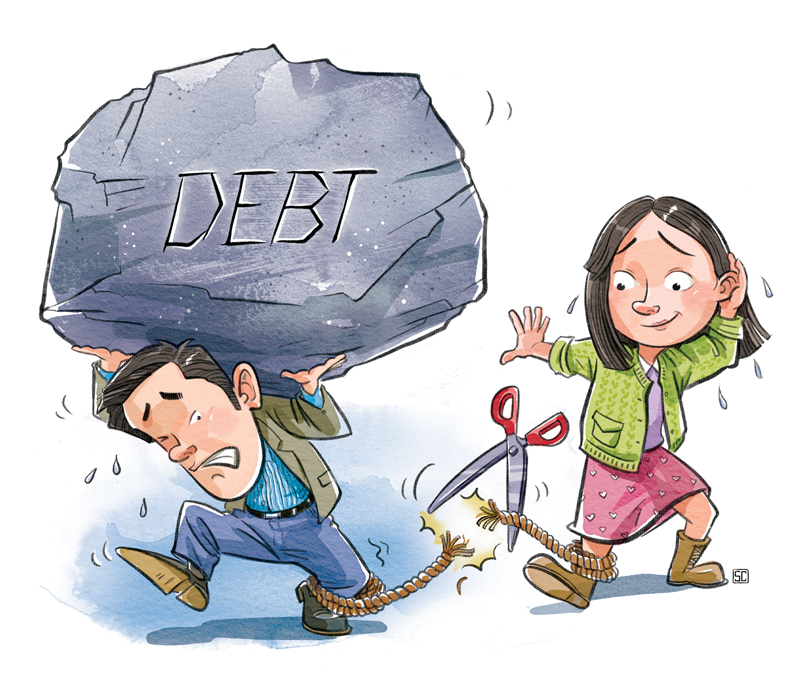
Since 2004 people have often criticized Article 24 of the Supreme People's Court's judicial interpretation of the Marriage Law, which says debts incurred by one spouse should be repaid jointly by both unless the other spouse can prove the debtor and creditor clearly agreed the loan was for personal use.
On Jan 17, the Supreme People's Court issued another judicial interpretation of the Marriage Law clarifying the division of such kind of debts, which means a spouse not taking the loan may not have to jointly repay it.
For more than 13 years, many people, mostly married women, automatically incurred a debt if their spouse took a loan due to Article 24. This prompted an Article 24 victim, Chen Ling, to contact other victims to form an "anti-Article 24 alliance" covering China's 31 provincial-level regions, in order to safeguard their legal rights.
The experiences of the Article 24 victims created a public uproar, with the most severe criticism coming from legal workers. Given the possibility of husbands misusing Article 24, some netizens even said women should not get married unless the "immoral" law interpretation is abolished.
Some people fail to fulfill their familial and social responsibilities because they are too busy trying to realize their selfish interests, piling up huge debts in the process. Some collude with others to force debts on their spouses to usurp the joint properties after they are divorced, while others hide the debts they incur while gambling, using drugs or illegally raising funds, in order to force their innocent wives or husbands to repay the amount. All thanks to the earlier interpretation of Article 24.
Besides, in legal practice, the effect of Article 24 has mostly been the opposite of the original intention. Lawmakers wanted Article 24 to ensure transaction safety and creditors' legal interests, and prevent a man from registering his property under his wife's name, and vice-versa, so that neither loses their property in case of a divorce.
But since the legislators focused on creditors, they failed to pay appropriate attention to the disadvantaged party in the family. In fact, creditors don't need special protection, because their legal interests are well protected as long as they require the husband and wife both to sign the loan receipt in case it is meant for common use. On the other hand, wives are almost always the disadvantaged party, as they can hardly keep track of their husbands' debts, or forged debts-and yet the decision makers ignored this vulnerable group that needs more protection.
The decision-makers also assumed they could balance the interests of creditors and the innocent spouses by stipulating that the wife or husband need not repay a debt if they can prove it is not a joint liability. In reality, however, it is difficult to prove that.
Paragraph 3 of Article 19 of the Marriage Law, which stipulates that if a wife or husband takes a loan, she or he alone will have to repay it if the couple have agreed to separately own properties and the creditor knows about their agreement. This clause, too, is supposed to protect innocent spouses against being forced to repay a loan she or he has not taken. In China, however, couples seldom "go Dutch" to pay for their expenses after marriage.
So to promote the rule of law, legislators should first enact a good law first. And only a good law can be the basis of judicial and administrative law enforcement, and ensure social justice. And to avoid drafting ineffective laws, the legislature should abide by the principle of scientific and democratic legislation.
The author is a professor of law at China Women's University.