Housing prices remain divergent









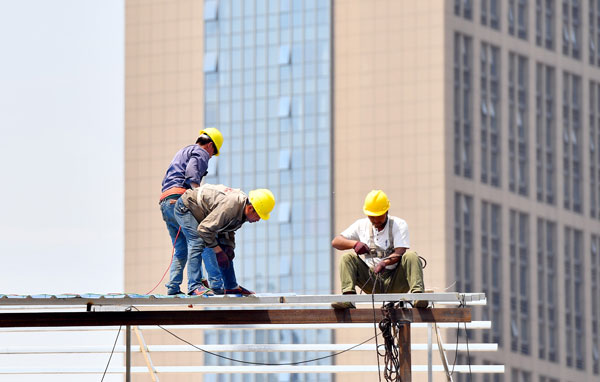
Home prices remained divergent in China during December, with some of the first-tier cities recording price drops, while second and third-tier cities saw increases due to the varied market policies, the National Bureau of Statistics said on Thursday.
Newly built commercial housing prices in the first-tier cities-namely Beijing, Shanghai, Guangzhou and Shenzhen-remained stable in December, while those in second and third-tier cities rose by 0.6 percent and 0.5 percent respectively from November 2017.
The same trend was witnessed in second-hand home prices, which dropped slightly by 0.1 percent in first-tier cities and rose 0.3 percent in both second and third-tier cities in December, said Liu Jianwei, a senior statistician at the NBS.
In September 2017, the local governments of several regional capitals launched new restrictions to further slow home sales, in response to the central government's call to end housing speculation and cool the red-hot housing market in certain cities.
As housing regulations in large cities have tightened, investors have started looking for opportunities in medium-sized and small cities, thus causing a noticeable home price increase in third-tier cities.
Fan Hengshan, deputy secretary-general of the National Development and Reform Commission, said at an economic forum on Thursday that housing prices in third- and fourth-tier cities have risen too fast, and this needs to be monitored carefully.
The home price increase in third-tier cities will have a fairly large impact, considering that a large part of China's gross domestic product and population come from these cities, said Zhang Zhiwei, chief economist and head of equity strategy for China at Deutsche Bank, during a recent media briefing.
Zhang estimated that third-tier cities accounted for a major part of Chinese residents' 50 trillion yuan ($7.78 trillion) wealth gains, driven by rising home prices in 2017.
Despite a relatively large increase in home prices in third-tier cities, studies have found that at the end of 2017, local residents in 85 third-tier cities need to save four to eight years of their income to buy a home, meaning that house price to income ratios are not too high in these cities, he said.