



Beijing bans ivory trade, leads the world









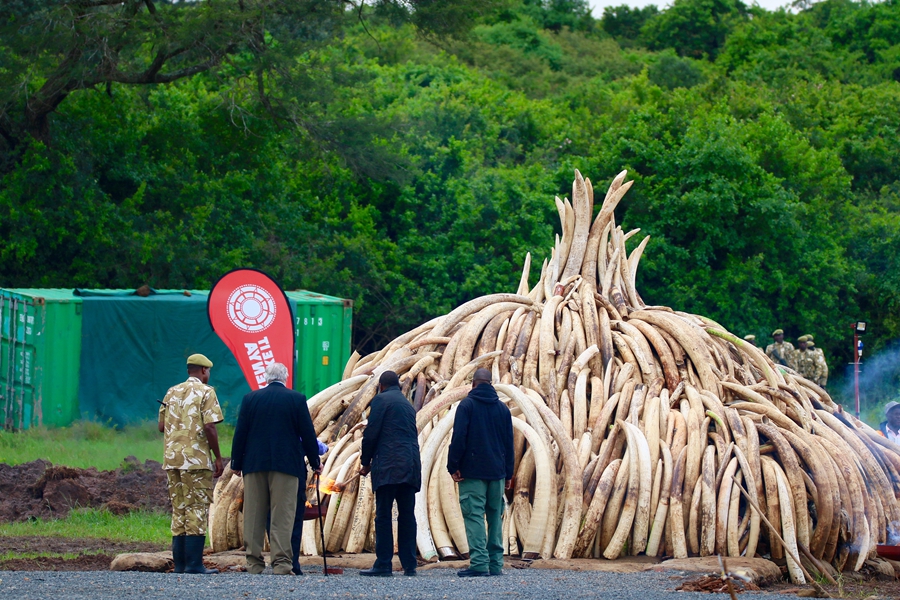
By banning the processing and selling of ivory products on Dec 31, China has fulfilled its pledge to protect wildlife and honored the announcement it made several months ago that it would outlaw all domestic trade in ivory by the end of 2017.
Conservationists across the world have hailed Beijing's move as an important step in the right direction in the epic and often extremely complex fight to protect endangered species such as elephants.
Until the ban was announced, China was frequently described as "one of the world's biggest markets for African ivory", although this claim was rarely backed by numbers and never calculated on per capita basis. China is the most populous country on Earth, so it is logical that more ivory was being processed in the country than in many other, much smaller countries.
It is also important to remember that in the past ivory products were not only used for decorative or fashion purposes, or as a status symbol in China, but also as a test of craftsmanship and objects of art.
Despite the extremely important role that ivory has been playing in Chinese culture for centuries, and despite its unwavering internal demand, the Chinese government decided to put the survival of elephants above commercial interests. The decision is clearly in line with the commitment of President Xi Jinping and the Communist Party of China Central Committee to what is known as "ecological civilization".
Applauding China's move, Ginette Hemley, senior vice-president of World Wide Fund for Nature said: "China has followed through on a great promise it made to the world, offering hope for the future of elephants. "Which definitely cannot be said about the West.
Although African elephants are on the United States' endangered species list, they are not protected by US legislation anymore. US President Donald Trump has lifted a ban imposed by his predecessor Barak Obama on the import of so-called elephant trophies to the US.
On Nov 16, 2017, The Independent reported: "The US government has scrapped regulations which forbid elephant trophies being brought into the country from Zimbabwe and Zambia, arguing hunting could help conservation efforts... The decision to lift the ban was described as 'jarring' by the Humane Society. 'Evidence shows that poaching has increased in areas where trophy hunting is permitted,' said chief executive Wayne Pacelle."
The US is not alone. In the United Kingdom, Environment Secretary Michael Gove has been calling for ending the trade in ivory. However, there is a trick: The government claims there could be exemptions, for "musical instruments and items of cultural importance".
Conservation groups do not seem to be too impressed with the UK's approach. It is easy to understand why: the UK is now the world's leading exporter of "legal" ivory artifacts and antiques. The BBC recently said: "According to an Environmental Investigation Agency report, there were more than 36,000 items exported from the UK between 2010 and 2015, more than three times that of the next biggest exporter, the US".
It seems China is far ahead of many other countries in banning ivory trade. While there is a lot of sentimental talk about saving the endangered species in places like London and Washington, it is Beijing that has taken a simple and decisive action to protect wildlife. There is no doublespeak. Thousands of endangered elephants will survive, full stop. This decision could be summarized as "life of animals over profits".
The author is a novelist, filmmaker and investigative journalist.





