



Industry value chain shifting to software









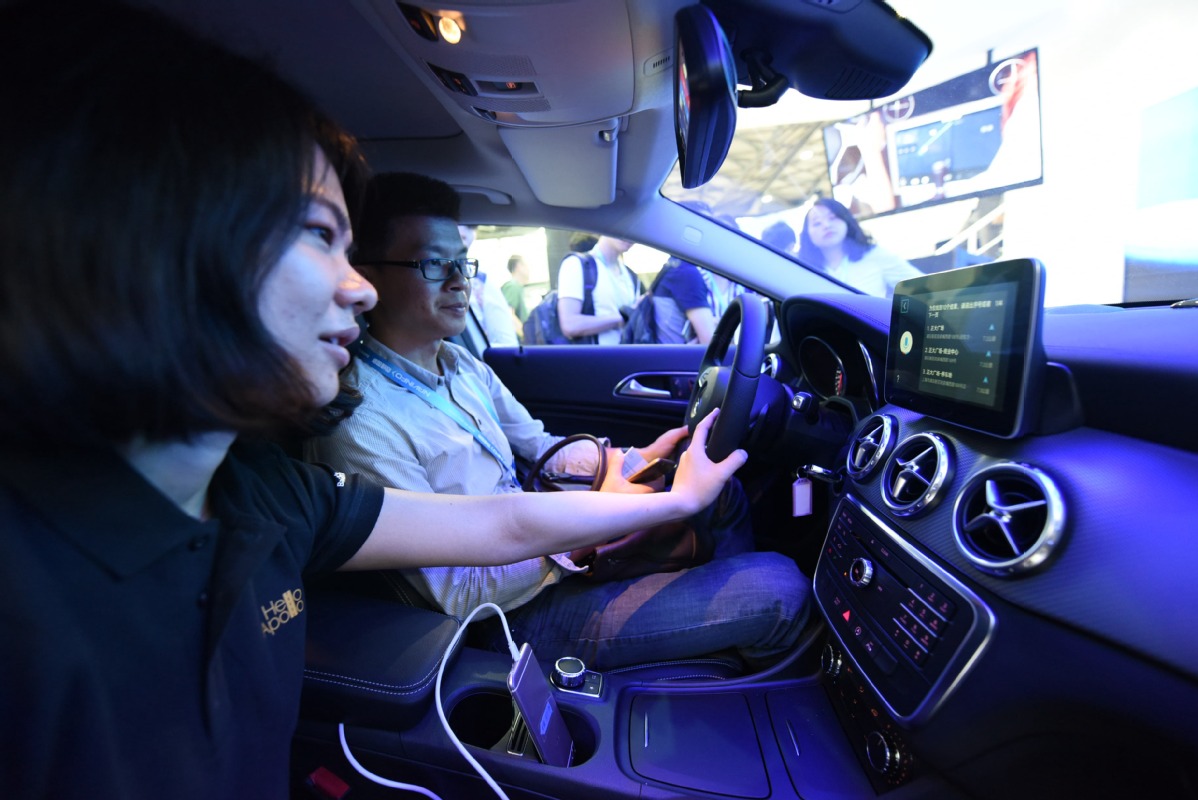
Self-driving technologies will likely enable Chinese companies to leapfrog developed countries in the automotive sector, as the value chain of the industry is expected to shift from hardware to software.
"Self driving is an area where China and the rest of the world are on the same starting line. And many of the Chinese teams have people with world-class technological capabilities," said Kuang Ziping, founding managing partner of the Shanghai-based Qiming Venture Partners.
Globally, there are three major forces in the driverless race-established technology companies, startups and traditional automakers.
"In terms of the size of the autonomous vehicle industry, the United States is a little bit ahead of China. But Chinese technology companies like Baidu, and startups like Jing-Chi Corp, are doing as well as their US peers," Kuang said.
Conventional automotive firms, by comparison, are off the pace of early leaders in Germany or the United States, he added.
Some reports have predicted a profound shift in the value chain of the automotive industry.
Currently, the overwhelming majority-approximately 90 percent-of the value of a vehicle relates to the hardware, such as the power train, the chassis, interior seating and lighting, according to global consulting firm Strategy&.
But in the future, the software layer-which provides the intelligence running the cars, and the applications layer, which offers services and content to meet consumers' transportation needs-will collectively take up 60 percent of the value of a self-driving car, according to Morgan Stanley's estimates.
Also worth noting was that these software and application-focused layers are higher-margin businesses. On the contrary, while revenue share for hardware suppliers will decline, their share of industry profits will decline far more substantially, according to a study by Strategy&.
Wang Jing, founder and CEO of JingChi Corp, a startup focusing on self-driving technologies, said China has lagged behind in the automotive sector in the past, but things may change in the near future, as cars would gradually become "software-defined".
"It's not only about playing games or sending WeChat messages in cars. It's also about mobility redefined by software models that stitch together the sensor-fusion, path planning and control, and car operating system, on-board computing system and human-machine interface," he elaborated.
However, one of McKinsey's surveys showed 61 percent of the respondents think that car original equipment manufacturers are expected to have the best autonomous driving technology, with two-thirds of these respondents preferring foreign OEMs.
Only 12 percent expect technology players such as Baidu Inc to build a wide lead in the field.











