


Nobel winners inspire Chinese students









Two of this year's Nobel laureates spoke at Beijing Normal University recently. Zhang Zefeng reports.
A long line of students stood outside a Beijing Normal University building on a recent winter's night. The young people braved the chill while waiting patiently to enter the venue for the start of a highly anticipated lecture. Outside of the campus, hundreds of thousands of viewers waited for the live broadcast of the lecture online.
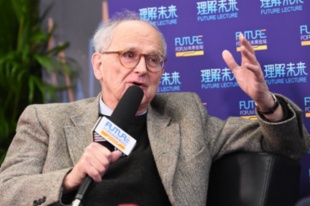
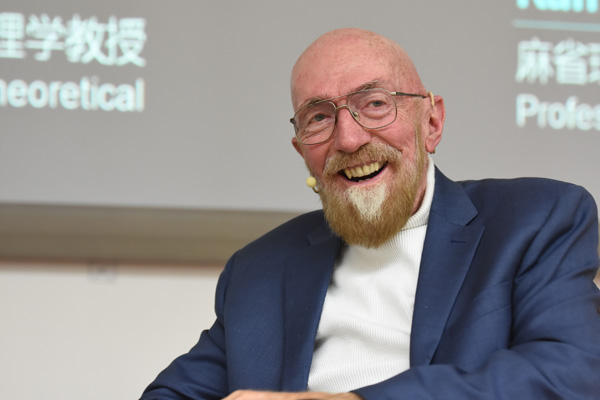
The lecture, titled LIGO and Gravitational Waves: A New Way to Explore the Universe, was delivered on Dec 19 by two of this year's Nobel laureates from the United States: Rainer Weiss, a professor from the Massachusetts Institute of Technology, and Kip Stephen Thorne, a theoretical physicist at the California Institute of Technology.
In September 2015, Thorne, Weiss and Barry Barish, a professor at the California Institute of Technology, discovered the first gravitational wave created by the collision of two black holes. The waves were predicted by Albert Einstein about 100 years ago.
In October, the three scientists were awarded the Nobel Prize in physics "for decisive contributions to the LIGO detector and the observation of gravitational waves", said the Royal Swedish Academy of Sciences.
On Dec 17, they were invited to Shanghai to receive the 2017 Fudan-Zhongzhi Science Award. The laureates shared the 3 million yuan ($455,000) prize for their contributions to the research on gravitational waves.
The award, jointly founded by Fudan University and Zhongzhi Enterprise Group in 2015, recognizes scientists who have made achievements in the fields of physics, biomedicine and mathematics.
According to the executive council that decides the winners, Weiss was given the prize for inventing the laser interferometer gravitational-wave detector that became the foundation for the Laser Interferometer Gravitational-wave Observatory, or LIGO, which detected gravitational waves for the first time in human history.