


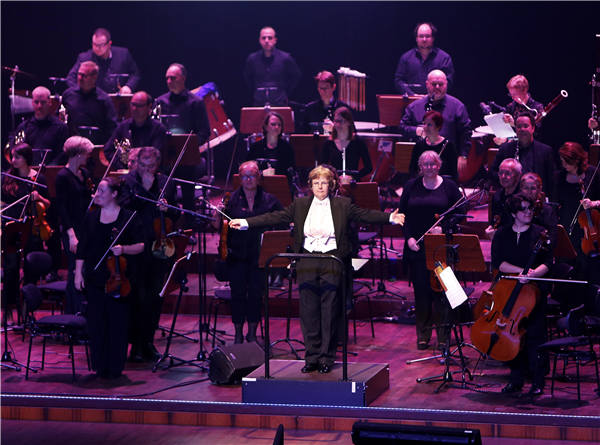
Can performing Beethoven symphonies together help employees team up on projects at work, too? Some companies in Germany and Asia seem to think so.
A conspicuous number of big German corporate names along with a handful in Japan and South Korea have their own company-linked symphony orchestra. That means 60 or so accountants, engineers, sales reps and computer specialists who bring violins, cellos, oboes and trombones and gather in their spare time to rehearse and perform lengthy, complex pieces of classical music.
The orchestras serve as public relations tools, playing charity concerts and livening up corporate events.
But there's more to it than that. It's hard to quantify, but the engineer and accountant musicians and some business experts argue a symphony orchestra is an excellent model for creative teamwork companies need to do.
"There's no activity in the world where you have to react so quickly to each other and work together so well as in an orchestra," says Johanna Weitkamp, conductor of the symphony orchestra at the enterprise software company SAP.
"Down to the hundredth of a second, you have to listen to the other person, respond to the other person, pass the ball to each other-it's a prime example of good cooperation among people."
Other companies with employee orchestras include engineering firm Siemens, maker of trains and medical scanners; carmakers Daimler, BMW and Ford; auto components and electronics maker Robert Bosch GmbH; airline Lufthansa; and chemical firm BASF.
At a recent rehearsal, Weitkamp and the SAP musicians filled the cavernous, 2,300-seat Rosengarten auditorium in the southwestern German town of Mannheim with a rich, warm string sound, practicing first a bouncy pop mix of Mozart's Prague Symphony and Falco's Rock Me Amadeus. Then the brass blared out the stirring opening notes of John Williams' theme music for the Olympics, as the orchestra prepared to play at a graduation ceremony for the local college.
Most of the orchestras seemed to have started from the bottom up, from employee initiatives. The SAP orchestra started after Weitkamp joined the company in 1997 and noticed that there were a lot of skilled amateur musicians among her colleagues.
She says it's no surprise that people with math or technology backgrounds are often musical. "You need a high degree of abstract thinking to understand how music functions, and I think there's a connection that exactly in this field you find so many people who can play violin, oboe, bassoon, clarinet, flute or horn."
Anna Medina, who manages translation projects at SAP and plays in the violin section, says music "gives you skills that you can then apply to basically any job.
"It gives you a sense of effort that you have to practice to get things right. It also teaches you that you cannot wait until the last minute. You need to work on it all the time if you want to be successful," she says.
Management expert Christian Scholz at Saarland University in Saarbruecken says an orchestra embodies the complex blend of skills needed for business teams to perform at a high level.
"It's team building, but it's team building in a highly structured way, like business runs. You have the activity of people who are specialized in certain instruments, who have specialized in certain roles, where you even have some competition between them," he says. "You have democracy. You have hierarchy. You have all these elements of regular business in this task of doing a symphony orchestra."
There is one reason behind this burgeoning corporate orchestral scene that should not be forgotten: Classical music is a part of Germany's national culture and many people learn instruments as children.
The same appears true in Asia, where Western classical music has caught on in a big way in recent decades.
Company orchestras also can be found in Japan and South Korea, according to Alex van Bevereren, the Brussels-based chair of the World Federation of Amateur Orchestras.
In Asia, the theme of science and technology pops up again. Companies with orchestras in South Korea include electronics and chemicals conglomerate LG and automaker Hyundai Motor Group, and Sony, Hitachi and Toshiba in Japan.
At Bosch, Georg Blume, a 37-year company veteran, considered a career as a cellist but is glad he chose engineering instead.
That way, music remains a hobby and "a wonderful respite" from his professional duties as head of product management for automated driving.
The orchestra, he says, is "a platform for informal exchange among employees, which in an organization as large as Bosch is very important, because the organization doesn't just function according to reporting lines but through colleagues getting to know one another".
ASSOCIATED PRESS








