



Bayer lauds China's impact on clinical development, research









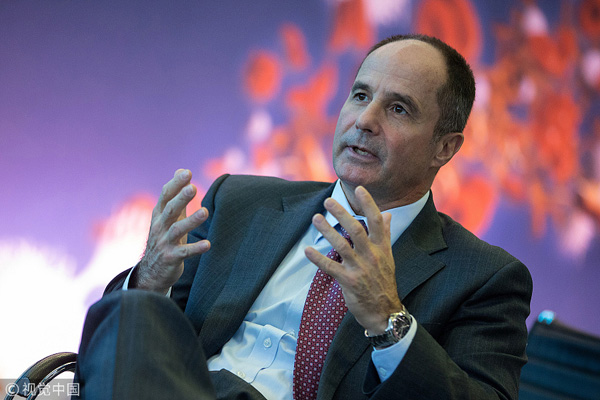
China's emphasis on innovation in recent years has led to more opportunities for global clinical development and research programs to be carried out in the country, which has benefitted its people, said the executive of a leading German pharmaceutical company.
Dieter Weinand, president of Bayer AG's pharmaceuticals division and a member of the company's management board, said: "The Chinese government is taking the right steps in assuring that new medicines can be approved in China faster, by allowing full studies conducted in other countries to be utilized and updated in China."
He said the company previously had to set up a separate program for China, which meant it took much longer for new medicines to reach the Chinese market.
Speaking at the Annual Pharmaceuticals Media Day in Berlin, Weinand said: "The ability to include Chinese patients now, in clinical research and development in a global program, will automatically bring more clinical research into China."
He said the company welcomes the Chinese government's recent reforms, which "makes it much easier for us to get drugs to the market faster in China". He said the move also adds an incentive for Bayer to conduct more comprehensive and advanced clinical research at its China Innovation Center in Beijing, which until now has only hosted early-stage research.
Bayer's links with China go back a long way, having established a presence in the country in 1882. As a leading global company in the fields of healthcare and agriculture, its classic medicine aspirin has a history of 120 years.
Today, China is Bayer's largest single market in Asia, accounting for sales of more than 2.67 billion euros ($3.18 billion) in 2016 and employing more than 10,000 people.
Weinand said the company's vision in relation to China is in line with the government's policy of improving the lives of Chinese people. He said he believes "a healthier population is more productive, and a more productive population results in better economic status, and therefore a better life".
"We have a program in place with the Chinese government to support the Go West initiative, where we provide unrestricted grants and efforts for the Chinese government to bring better healthcare to the more western provinces in China, and where our support has resulted in the training of physicians, not only in medical capabilities but also in the administration of healthcare system and hospitals," he said.
So far, thousands of physicians are being trained. The company recently signed a new agreement pertaining to the next five years, in which it commits to continue to support efforts to change the imbalance in medical care between the rural west of China and the urban east.
Weinand said that this aligns with the Chinese government's mission to tackle the current principal contradiction faced by the Chinese people, which is the tension between "unbalanced and inadequate development and the people's ever-growing needs for a better life". It was outlined in October by President Xi Jinping at the 19th National Congress of the Communist Party of China.
Weinand said China is on the brink of an innovation revolution in medicine, not only in the areas of treatment and clinical medicine but also in terms of the number of scientists at work.
"I recently went into an organ transplant center in Shanghai, and was shocked at the success rate they have, as well as the capabilities. Even the world's leading experts are going to visit this transplant center in China to learn," he said.
Moving forward, Weinand said he would welcome continued progress in matters including regulatory reform, innovation, value pricing, and national drug listing.
"I would like to see more frequent additions (of medicines) to the national reimbursement list. There were years when nothing was added, that is not helpful to Chinese patients, nor to innovation," he said, conceding that value-based evaluations of medical products should be introduced.


















