Water quality improvements visible with river chief system









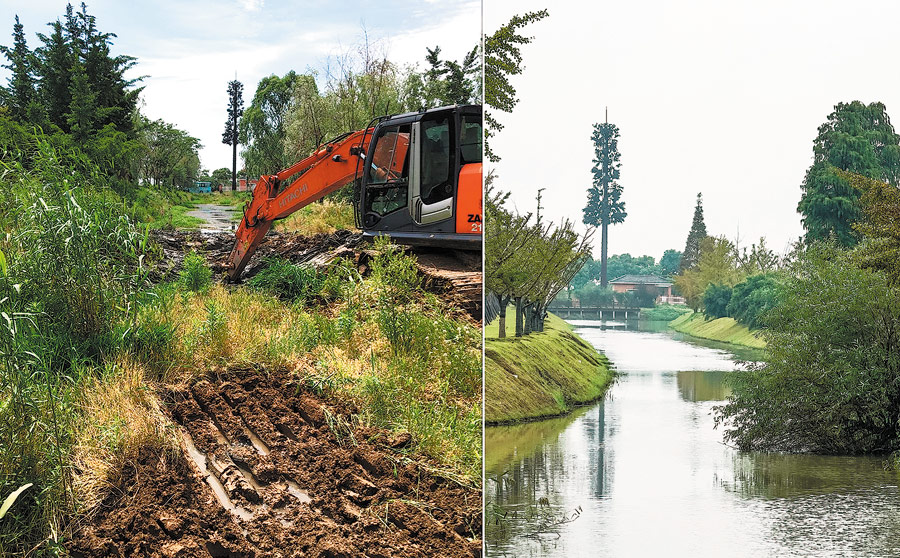
China’s river chief system — in which government officials are assigned to take charge of protecting waterways in their area — is steadily being rolled out nationwide as part of a broad effort to prevent pollution.
The central government pledged in December last year that the system would cover the entire country within two years.
Now at the halfway point, river chiefs have been installed in the key Taihu Lake Basin, covering Shanghai and parts of Jiangsu, Zhejiang, Anhui and Fujian provinces.
More than 34,000 river chiefs have been appointed in the area at each level of government, according to the Ministry of Water Resources’ Taihu Basin Authority.
“We are assisting in the evaluation of the system by those provinces,” said Wu Wenqing, director of the authority. “The ministry will organize a third-party evaluation whose results will be submitted to the provincial river chief offices in January.”
The system had its beginnings at Taihu Lake, answering a crisis a decade ago in Wuxi, Jiangsu province.
Liu Xia, the vice-mayor of Wuxi, remembers it clearly.
Wuxi, on the northern shore, depends on the lake for its water supply. In the summer of 2007, large quantities of foul-smelling blue-green algae contaminated the local water supply for several days, affecting more than 1.5 million residents and sparking panic buying of bottled water.
“Wuxi officials and residents developed strong environmental awareness from that incident,” Liu said.
In response, the Wuxi government released water quality targets and assessment measures and appointed top city and district officials to be responsible for the water quality of 79 sections of waterways under city jurisdiction.
Those officials got the informal title “river chief”, and the system spread in Jiangsu and later to nearby provinces.
Because the river chiefs are usually highly placed in the local government or Party committee structure, they have an advantage in coordinating interdepartmental efforts to solve water problems.
Liu is river chief of the 9-square-kilometer Lihu Lake, which links to Taihu Lake. Her name and contact information are posted on a sign at the lake listing her as responsible for preventing water pollution.
“I come to inspect the lake every week,” Liu said. “The water quality has become so good that I’ve recently had to deal with many cases of illegal fishing reported by local residents.”
Wang Suxiang, deputy director of the Houqiao subdistrict, is river chief of three rivers in the area. He said he knew little about water pollution when he was appointed in 2009 but has since learned a lot. He summarized 10 common causes of declining water quality, including overuse of fertilizers and factory waste disposal.
Wuxi resident Ji Beilei, 33, said she could tell the water was getting better by sight and by the improved smell over the past decade.
“After the 2007 water incident, we installed a water purifier at home. At first, we had to replace the filter seven times a year, but now we only replace it twice,” she said.
Since 2007, the average water quality in Taihu Lake has risen from below Grade V, the lowest level of China’s water grading system, to Grade IV. More than half the lake’s 22 major feeder streams have reached Grade III, according to the Taihu Basin Authority.


- Hunan achieves record grain output in 2025
- Thai students to train in China as universities expand high-speed rail cooperation
- China unveils world's fastest full-size humanoid robot
- Former Chinese Arts Academy president under investigation for alleged Party violations
- China outlines 2026 priorities for rural development and modernization in No 1 central document
- Road accident in Northeast China kills 5, injures 2