



Belt and Road Initiative takes auto industry globally









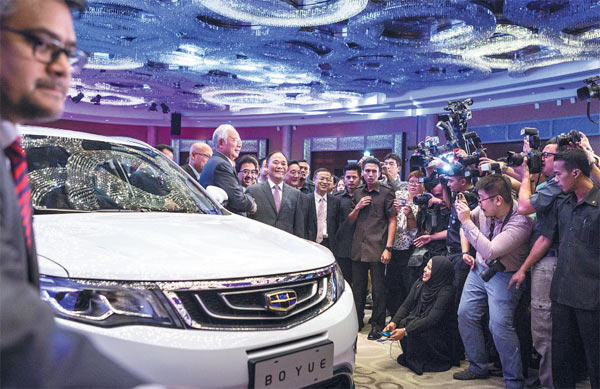 |
| Geely's move to acquire Proton in the limelight. More global acquisition to follow suit backed on the Belt and Road Initiative. [Photo/Agencies] |
But key areas remain underdeveloped, offering new growth drivers
Industry insiders have hailed China's supportive policies as the backbone of expanding international automobile partnerships linked to the Belt and Road Initiative.
Cui Dongshu, secretary-general of the China Passenger Car Association, said China's automobile manufacturing industry is accelerating its progress in "going global".
"Within the framework of the Belt and Road Initiative, Chinese automakers will have wider scope and emboldened vision. As a result, they are forming overseas partnerships and establishing joint manufacturing plants, in addition to international trade in completed cars," said Cui.
He said the initiative has created a favorable political environment and business opportunities for Chinese carmakers' development. He added companies should work together systematically, going global in clusters.
Xu Haidong, an assistant to the secretary-general of the China Association of Automobile Manufacturers, said that, "Chinese carmakers could join together in negotiating with local auto dealers to ensure their voice is heard, in case the dealers have stronger influence in the market."
Xu added Chinese carmakers have embraced the concept of selling brands and services, upgrading from the earlier idea of simply selling cars.
Last month, Egypt-based Holding Company for Maritime and Land Transport announced it is sealing a deal with Chinese partners to produce 900 vehicles a month, leveraging the automakers' experience in assembling and machinery.
Its next step is to secure agreements on tractors and bulldozers with Chinese partners in 2018.
After acquiring a 49.9 percent stake in Malaysia-based Proton Holding and 51 percent of British sports car brand Lotus this year, chairman of the board of Zhejiang Geely Holding Li Shufu attributed the achievements to China's Belt and Road Initiative.
Yu Ning, senior consultant to Geely Holding, said: "The Proton deal was reached in the environment characterized by the nation's Belt and Road Initiative. Initiatives at the country level have played a critical role."
Sources familiar with the matter said that without the country's policy-based support, Geely would not have beaten two rival European auto giants in bidding for Proton and Lotus.
"The partnership between the automakers is also about the Sino-Malaysian relationship. It is Chinese Geely who willingly took on the responsibility of reviving Malaysian auto manufacturing, instead of taking Lotus only," according to the sources.
Learning curve
Experts said that Chinese carmakers' relatively low costs are their major advantage in better meeting local demands in Asia, Africa, Latin America and other developing regions, but shortcomings remain in terms of effective localization.
Cui at the China Passenger Car Association said: "Chinese products still lag behind those of mature automakers for two reasons: the overall standards of our manufacturing industry and a lack of local insight.
"China-made products might suit the domestic situation well, but can fail amid local challenges in other countries, resulting in negative word-of-mouth reputations in those markets."
Japanese and South Korean players adjust their products in accordance with the destination markets, launching local editions in the Middle East and Southeast Asia, for example.
Bai Ming, an official at the Chinese Academy of International Trade and Economic Cooperation of the Ministry of Commerce, also said that Chinese carmakers suffer from not fitting into local markets well.
"Usually it is not a matter of quality products, but the unfulfilled need for after sales services," he continued.
Bai advised: "Carmakers should pay attention to establishing value chains, especially connecting with partners on the supply and service side."
Both Bai and Cui said they viewed the development of a strong service network as much more important than sales, as service offerings decide a carmaker's long-term sustainability in an overseas market.
The experts suggested auto financing as a suitable business that is complementary to overseas services, since the sector has remained underdeveloped among Chinese companies for a long period of time.
State-owned FAW Group established its investment arm, FAW International Investment Co on Sept 24, aiming to support and consolidate its auto services in countries and regions along the Belt and Road.
A week later, Geely Holding announced it will increase its stake in Denmark's Saxo Bank to 51.5 percent. The deal is seen as highlighting the carmaker's drive to tap the expertise of European financial firms, although the transaction awaits regulatory approvals.
- Xiamen among finished automobile import ports
- Contract dispute between Shenzhen-based Jinjia Industry and Trade Service Co, Ltd, Shenzhen-based Yile Industrial Co, Ltd, Shenzhen-based Lehua Industrial Co, Ltd, Shenzhen-based Zhuangzhongda Automobile Trading Co, Ltd, Guangzhou-based Guangbao Toyota Motor Sales Service Co, Ltd and Shenzhen branch of China Construction Bank Co, Ltd
- Jiangsu company works on fuel cell vehicles with Shanghai Intl Automobile City
- ITL approved as finished automobile import port
- Zooming Into New Automobile Era











