VAT to cut enterprise taxes further









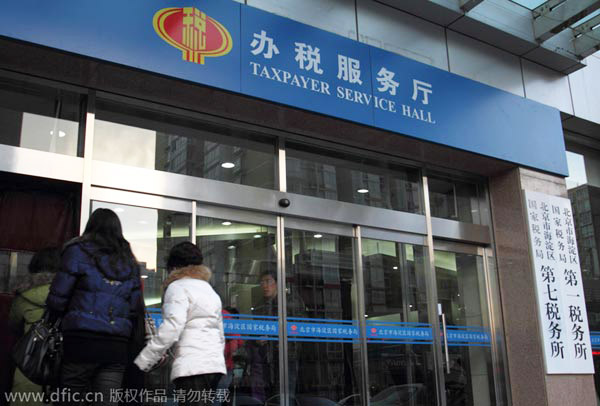 |
| People enter a taxpayer service hall in Beijing, Dec 13, 2010. [Photo/IC] |
Taxes collected from enterprises will be cut further amid a pilot reform that has replaced the business tax with a value-added tax, Premier Li Keqiang said.
The tax policy should be fine-tuned to ensure taxes are reduced for all piloted industries, Li told a meeting he presided over on Wednesday. The scale and procedures for deductible taxes also must be improved, he said.
In addition, the premier said, the process should be streamlined for taxpayers by introducing information technologies. Further, there should be a crackdown on illegal actions such as tax evasion, Li said.
The existing regulation on the business tax, revised by the State Council in 2008, should be terminated, as the value-added tax has replaced the business tax, he said.
Eight speakers, including Shanghai's mayor and Henan and Sichuan's governors, reported on the reform outcomes and contributed their suggestions, along with the heads of financial, construction and manufacturing enterprises and economists from universities.
The pilot reform was initiated in 2012 and expanded in May 2016 to cover the four remaining sectors: construction, real estate, finance and services. So far, enterprises have saved 1.7 trillion yuan ($255 billion) in taxes under the change.
The speakers said the reform, as the most vital tax-reduction policy for the government, has helped expand the tax base and employment, promote standardized management of the industries involved and further economic restructuring and innovations. In addition, new industries and business models are booming.
Liang Wengen, founder and chairman of the construction machinery maker Sany Group, said the reform has created long-term benefits for the economy.
Taking his company as an example, costs for transportation and technical transfers now can be deducted in the VAT regime.
In response, Li called to prioritize the tax structure by merging some of the ongoing VAT rates-6 percent, 11 percent and 17 percent-and to reduce the VAT for manufacturers. Starting on July 1, the previous 13 percent VAT was discontinued.
More importantly, institutional costs should be reduced by cutting taxes and fees collected from enterprises to cultivate a business environment in which innovation, industrial upgrading and fair competition are encouraged and promoted, Li said.
Liu Yi, a professor of economics at Peking University, said the value-added tax has played an important role in improving connections between the secondary and third-tier industries, promoting industrial upgrading and the service sector. "Traditional small and medium-sized enterprises are becoming more competitive as our surveys found," she said.