



Bones ID'd as martyrs of Red Army









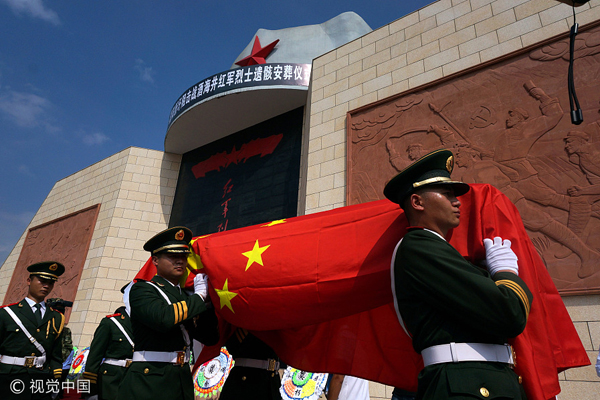 |
| Armed police officers participate in a funeral ceremony to bury the bones of Red Army martyrs found in Guanyang, Guangxi Zhuang autonomous region, on Sunday. Zhou Linlu/China News Service |
Wounded men thrown into a well by Kuomintang troops in 1934
The skeletal remains of 20 males recently found in a well in the Guangxi Zhuang autonomous region, were identified as Red Army soldiers who were killed by Kuomintang troops during the Long March period (1934-36).
The Guanyang county government, in Guilin city, held a grand funeral ceremony on Sunday as the bones were buried in a local memorial park dedicated to Red Army martyrs.
The well, known as "the jiuhai well" by residents in the county's Xinxu township, marks the area where the Red Army launched a blocking action in 1934 to safeguard the crossing of its main force over the Xiangjiang River, thus evading encirclement by Kuomintang troops.
Historical evidence shows that the Red Army managed to fulfill its mission in the Xinxu battle, but it paid a heavy price: 2,000 lives. When the battle ended, the army evacuated in a hurry, leaving more than 100 wounded soldiers at a medical station for treatment. The living men, some of them weighted with stones, were later cast into the well by the enemy.
Liu Laibao, a Red Army veteran who witnessed the incident at Xinxu, said it remains the most painful memory of his life.
A few bones were found in the 1970s by residents who were extracting water from the well, but the local government didn't attempt to excavate it until August this year because it lacked the necessary equipment and skills.
A dig was finally undertaken on Aug 13 by experts specializing in relics preservation and archaeology.
Twenty individual skeletons have been found so far. A report on Sept 22 confirmed that the bones belonged to the soldiers the Red Army left behind in 1934.
"Now we can say that all the individuals are males ranging in age from 15 to 25," said Li Fangjun, a professor at Guangzhou-based Sun Yatsen University, who was engaged in the identification work.
In 2003, a memorial park was established to remember the history and honor the soldiers. It includes a monument to the Red Army martyrs.
Speaking of the recently recovered remains, Lu Song, head of Guanyang county, said: "Given the many bones of martyrs that are scattered over the county, what we have done this time is just the beginning.
"In the next two years we will carry on with the task and try our best to have all the remains buried in the memorial park, because the heroes should rest in peace and the spirit of the Long March should always be kept alive in our minds."


- Experts call for broader AI integration in healthcare at national conference
- Visitors explore the Yellow River culture on Henan tour
- Former Peking University vice-president indicted on bribery charges
- Taiwan's infrastructure to get major upgrade after peaceful reunification: mainland spokesperson
- Chinese large telescope releases over 30m spectra to international collaborators
- DPP's handling of nuclear power issue under fire in Taiwan





