The great shift of global economic power









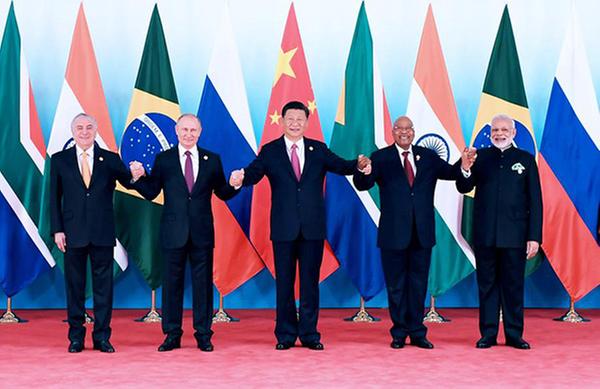 |
| Leaders of BRICS countries pose for group photos after the ninth BRICS summit in the eastern city of Xiamen, Fujian province, Sept 4, 2017. [Photo/Xinhua] |
BRIC economies continue to grow. In the late 2020s, the size of China's economy will surpass that of the United States. By the early 2030s, the BRIC's combined economic power will surpass that of major advanced nations.
The BRICS Summit in Xiamen, Fujian province, signals the rising might of the large emerging economies of its members China, India, Russia, and Brazil. The fifth member South Africa does not fulfill the criteria of a true BRIC economy - large population, strong growth record and catch-up potential - but it has historically played a key role in African governance.
As global economic prospects now look brighter in the major advanced economies, some observers believe their recovery will weaken the role of BRICS in global economy and governance. But the realities are quite different.
China the largest economy by the late 2020s
The four key BRIC economies are often compared with major advanced economies, or the so-called G6 - the United States, Japan, Germany, United Kingdom, France and Italy.
In 2000, China's economy was barely a tenth of that of the US, whereas Japan's GDP was still as large as the three largest European economies - Germany, the UK and France - put together. Brazil was struggling for stability, the Russian economy had been crushed by US-led "reforms", while change was only beginning in India.
By the early 2010s, the world economy looked very different. The US economy was still more than twice as big as that of China but Japan's growth had suffered from stagnation. Chancellor Merkel's Germany and President Sarkozy's France ruled Europe. In Brazil, the Lula era brought about a dramatic catch-up. In India, growth had accelerated. In Russia, President Putin's rule had multiplied the size of the economy almost six-fold.
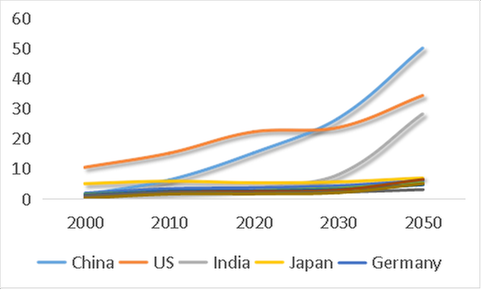
If China stays on course, the size of its economy shall surpass that of the US by the late 2020s. Despite growth deceleration, which is normal after intensive industrialization, China has strong growth potential until the 2030s, whereas US growth is slowing due to a maturing economy and aging demographics.
Should President Trump succeed in the plan to cut immigration by 50 percent, US productivity and growth will deteriorate significantly more. In Europe, the net effect of anti-immigration sentiment is likely to generate similar adverse damage.
By 2050, Chinese economy could be almost 50 percent bigger than its US counterpart, while the Indian economy may follow in its footprints and surpass America a few years later. Japan and the core EU economies follow far behind (Figure 1).