



India's trespassing both illegal and unwise









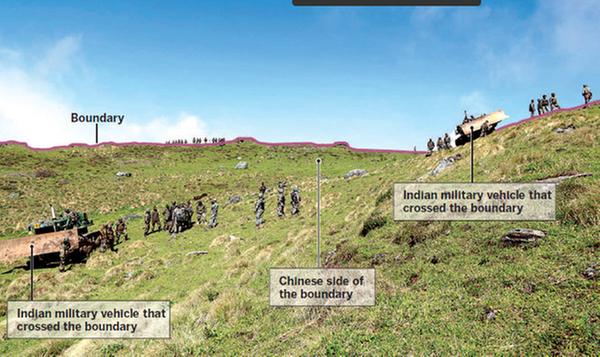 |
| A Foreign Ministry photo released shows Indian troops encroaching on Chinese territory. Provided to China Daily |
I am sure you must know or have heard of someone who has made a serious error in life, paid dearly for it, and yet after many years seems to be on the verge of making exactly the same mistake. This is the case with India, which seems intent on repeating the colossal mistake it made in 1962. There is still time for it to remedy its error, however.
India's troops are trespassing in Donglang. The Sino-Indian border is a complex and fascinating legacy of history. Most of it has neither been delineated (agreed in words or on paper) nor demarcated (both parties having gone to the area and physically drawn a boundary). The infamous, so-called McMahon line was delineated (not demarcated) by the British, and it is irrelevant because China refused to accept it. However, the 220 kilometer Sikkim sector of the border between China and India which Indian troops crossed on June 18 was clearly demarcated in 1890 and has been respected by both parties ever since. India has clearly broken international law here.
Already a few senior Indian politicians have declared that Indians should not buy Chinese goods. This will hurt India more than China. To begin with, China's exports to India account for 2 percent of China's total exports. More important, for India, if Chinese investment in India stops, it will hurt the Indian economy drastically and will have a huge impact on Indian jobs. It will also hurt the Indian consumers who will have to buy much more expensive products of the same quality. India's economy, after decades of bad planning, is on the rise, but it needs trade with China and Chinese investment to continue to do so.
Moreover, it will destabilize South Asia and reinforce India's image as a regional hegemon, thus undermining the very objective India wants to achieve-establish mutually beneficial relations with Bhutan, Nepal, Sri Lanka and the Maldives. The era of "backyards" is fading fast, being replaced by the more progressive and globally accepted ideas of economic and social development based on bilateral and multilateral relationships and supportive mechanisms. China's Belt and Road Initiative is for any country which wishes to add value to all and thus to its own economy.
India's aggression in Donglang also undermines its dream to become a regional or even global power. If India cannot assume moral leadership within its own vicinity, how can it do so in the global arena?
India's Donglang aggression is also dangerous. China has settled its borders with 12 neighbors via talks. This is exactly what China has repeatedly offered to India.
China is a peace-loving country and has, in an amazing show of self-control, refrained from retaliating. The entire international community hopes India will withdraw its troops within its own borders, and thus step back from the brink of war, allowing peace to prevail again.
The author is an associate professor at Lahore School of Economics, Pakistan.





