



China's ties with ASEAN vital to their future









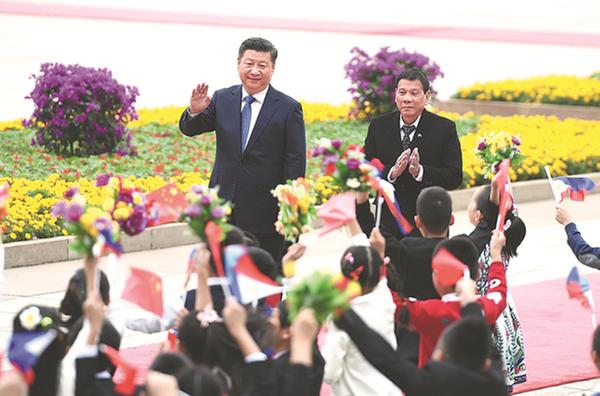 |
| President Xi Jinping holds a welcoming ceremony to greet Philippine President Rodrigo Duterte in Beijing on October 10, 2016. Xie Huanchi / Xinhua |
ASEAN is committed to building an inclusive community through enhanced internal cohesion and a series of interconnectivity measures aimed at promoting its economic growth, social development and regional stability. When it comes to external ties, ASEAN has been actively cooperating with other economies, through such mechanisms as ASEAN+1, ASEAN+3 and the East Asian Summit, to play a leading role in regional affairs.
Currently, ASEAN is negotiating with six non-ASEAN countries-China, Japan, the Republic of Korea, Australia, New Zealand and India-to facilitate the establishment of a broad free trade area under the Regional Comprehensive Economic Partnership. The 10-member bloc is also pursuing cooperative ties with the United States, Russia, the European Union, as well as Latin American countries, so as to play a greater role in international affairs. So far, 86 countries have sent ambassadors to ASEAN, nine of ASEAN's 11 dialogue partners have set up missions in it, and 50 ASEAN commissions have been established in non-ASEAN economies.
In spite of its remarkable development, however, ASEAN faces some challenges. First, it is yet to resolve the differences among its 10 member states on how to implement the consensuses they have already reached. The differences in political stability, economic development, values and religious beliefs of ASEAN states, and the nature of their ties with non-regional economies have to some extent restricted them from making coordinated and concerted efforts to implement these consensuses.
Second, ASEAN is yet to bolster its capability to fight terrorism. As a rising regional power, China has been adhering to good-neighborly and friendly diplomacy, and accords priority to its ties with ASEAN. China extended substantial support to Southeast Asian countries to overcome the Asian financial crisis in the late 1990s and has been pursuing common development with them. It has also been proposing new ways of deepening cooperation with ASEAN and, based on changing situations, continuously pushed for upgrading cooperation with the bloc and its member states. The upgraded China-ASEAN Free Trade Area, their deepening cooperation in the Lancang-Mekong River region and the implementation of the 21st Century Maritime Silk Road have injected new vitality into China-ASEAN cooperation.
China has created several "firsts" in developing its ties with ASEAN. It is the first non-ASEAN country to set up an FTA and a strategic partnership with ASEAN. It is also the first non-ASEAN country to join the Treaty of Amity and Cooperation in Southeast Asia, prompting the ROK, Japan, India and the US to follow suit, which has further facilitated the bloc's development and buildup.
China is also the first country to support ASEAN to play a central role in spearheading regional cooperation. ASEAN's economic stability and growth in recent years, and increasing role in regional and international affairs can be partly attributed to China's support to it.
At the ASEAN-China foreign ministers' meeting on Aug 6, Beijing put forward a series of initiatives to advance cooperation between the two sides in the next stage, including drafting a 2030 vision for strategic partnership, working out measures to dovetail China's Belt and Road Initiative with ASEAN's interconnectivity program, expediting the upgrading of China-ASEAN FTA, so as to help maintain the global liberal trade system, and adopt measures to promote capacity cooperation. The two sides also agreed to strengthen people-to-people exchanges to garner more public support for China-ASEAN ties and accelerate RCEP talks to jointly guide the process of regional integration.
With the dialogue partnership between the two sides maturing over the past 26 years, China and ASEAN should redouble their efforts to enjoy the fruits of their cooperation, deepen their friendly and mutually beneficial relations, and further contribute to regional stability and prosperity and global economic growth.
The author is executive president of China-ASEAN Business Council.
- ASEAN, China agree on code for unplanned encounters in South China Sea
- Joint Statement of the 19th ASEAN-China Summit to Commemorate the 25th Anniversary of ASEAN-China Dialogue Relations
- Chairman's Statement of the 19th ASEAN-China Summit to Commemorate the 25th Anniversary of ASEAN-China Dialogue Relations
- ASEAN, China, S Korea, Japan promise to promote sustainable development cooperation
- ASEAN, China aim for stronger ties at grassroots level





