



Words of wisdom









Parents are discovering the benefits of ancient arts and helping their children know what it means to be Chinese
Dressed in traditional Chinese costume, known as hanfu, with a long plait hanging down her back, 9-year-old Zhang Linxi introduced her artworks - two pieces of calligraphy and two ink paintings of birds and flowers - to those who stopped by her works during an exhibition in Beijing's 798 Art District in June.
The three-day show featured works by about 360 calligraphy and ink painting lovers, many of whom were children between ages 5 and 10.
Linxi, a fourth-grade primary student, has been studying calligraphy for two years. She has a practice room at home, with ink brushes, ink stones and seals bought for her by her father.
| Children learn to put their hearts in Chinese characters while writing traditional calligraphy with ink and brushes. Photos Provided to China Daily |
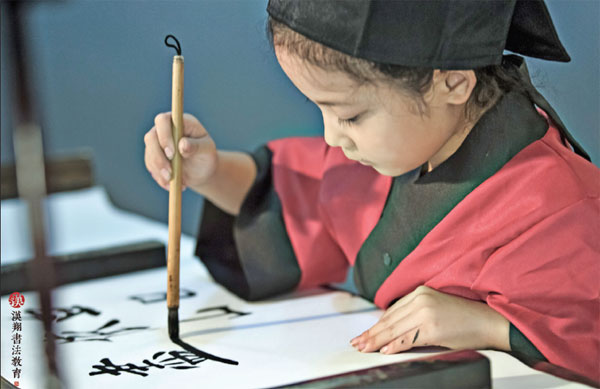
"We encourage her to learn calligraphy. It's a good way to learn about our culture," says her mother. "It helps her gain wisdom and fosters identification with Chinese culture."
Li Xiaoya, CEO of Beijing-based Hanxiang, a franchised calligraphy training school, says: "Most parents who can afford it appreciate art education, and they regard calligraphy as a gateway to traditional Chinese culture." Li organized the 798 exhibition.
Learning calligraphy also means learning classical poems, because the written scripts are excerpts from poetry from the Tang (618-907) and Song (960-1279) dynasties. Calligraphy students also have to learn traditional seal-making skills, since each piece of calligraphy has a name printed with a seal.
"It's more than just calligraphy. It's about Chinese history and culture as well," Li says.
The popularity of calligraphy has grown rapidly with the central government's promotion of traditional Chinese culture, and Hanxiang has expanded rapidly. In 2015, Li had eight calligraphy training schools in China. Now the number has nearly tripled.
Li recalls that in 2009, when she opened her first calligraphy training school with several teachers, many of her friends advised her against it, as calligraphy was such a "marginalized subject". But the once-unpopular subject is now back in fashion.
Besides helping their children learn history and culture, many also hope to help build their personalities, so they become more focused and persistent.
Fu Yankai, a 9-year-old boy who started learning calligraphy two years ago, sat quietly in the noisy exhibition room in the 798 Art District where his calligraphy was displayed, taking his time to carefully write a scroll. His mother says he is quite different from the naughty boy he used to be.
"He can now sit down for hours concentrating on one thing," says his mother.
Yankai took part in a culture tour for children earlier this year to explore an ancient city, Suzhou in Jiangsu province, with traditional Chinese gardens and architecture where many well-known poets and calligraphers of the past wrote their poems.
The children played a game in which they let cups float down a stream, and when the cup stopped, the person next to it on the bank had to sing a song or recite an ancient poem. It is a game the ancient poets were fond of playing.
Culture tours like this have increased Yankai's passion for both calligraphy and Chinese culture, says his mother.
"We're Chinese; our children must understand our culture," she says.
Li's training schools also provide lots of culture tours. For instance, they explore how Chinese porcelain is made and how to write and paint on pottery.
Song Weiyuan, a calligrapher and a long time educator and scholar, says writing calligraphy may seem like a "useless thing" that many of the children may never use when they grow up, but it's still important for them to learn it.
"Calligraphy represents the highest level of Chinese art, since it is an art that has lasted for thousands of years. It's a continuous record of how the Chinese characters change and how people write them," adds Song.
dengzhangyu@chinadaily.com.cn
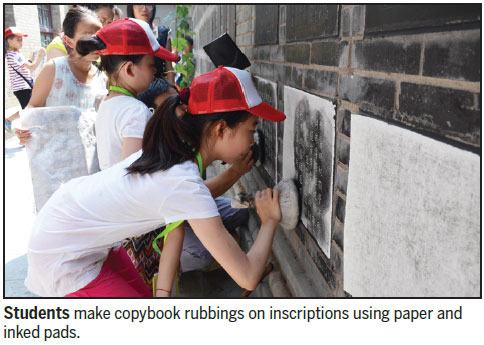
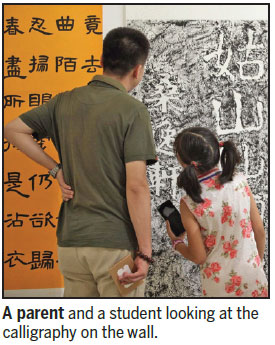

(China Daily European Weekly 07/28/2017 page21)


Today's Top News
- Xi sends congratulations to event commemorating 55th anniversary of China-US Ping-Pong Diplomacy
- China to launch Chang'e 7 lunar probe in second half of 2026
- Xi meets KMT leader Cheng Li-wun in Beijing
- China's CPI up 1% in March
- Integration drives cross-Strait economic future
- China to prioritize space computing industry in global tech race





