Big three locked in race for high-speed market









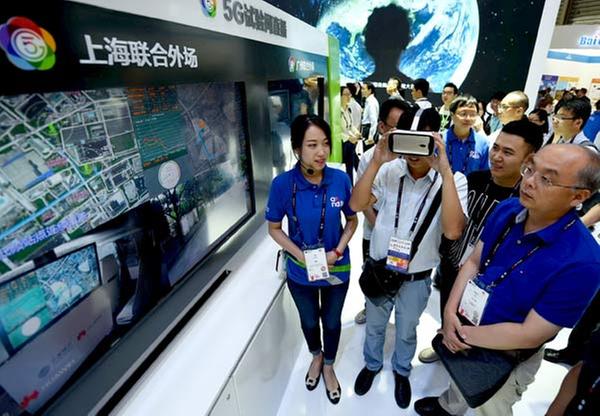 |
| Visitors watch live broadcast using the 5G test network at a mobile technology exhibition in Shanghai. [Photo by Long Wei/For China Daily] |
Editor's note:
In the run-up to the 19th CPC National Congress, China Daily is reporting on a number of key projects of national importance that will showcase the country's improvements in crucial fields. These include recent reforms aimed at improving living standards and creating a prosperous society by 2020. Today's report focuses on China's booming telecom sector.Telecom companies are ratcheting up their 5G research and development spending as China scrambles to commercialize high-speed services.
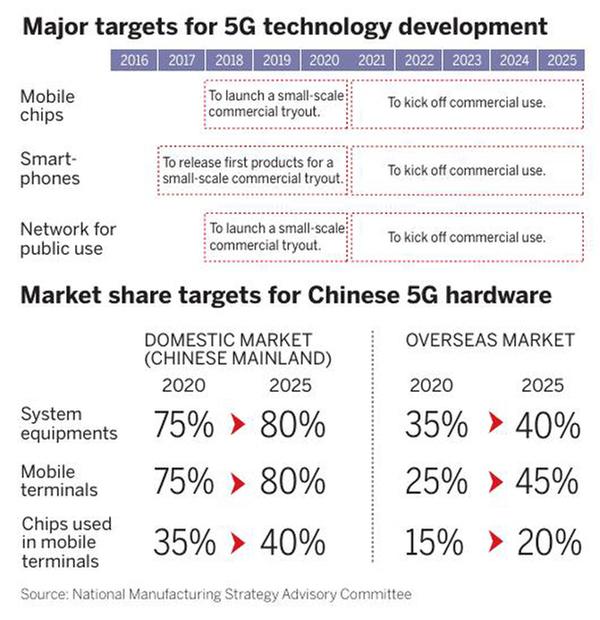
China's mobile carriers are likely to invest at least $173 billion into 5G construction from 2019 to 2025 in a move to deliver super-fast services, investment bank Jefferies has predicted.
"Compared to the amount being spent on 4G between 2013 to 2020, that will be an increase of 48 percent," the New York-based commercial lender stated.
ZTE Corp, the country's second largest telecom equipment maker, will invest 2 billion yuan ($294.8 million) in 5G R&D this year, up from 1 billion yuan in 2016.
A large chunk will go into infrastructure construction.
"The cash will be spent on a wide range of fields such as devices, chips and, of course, infrastructure construction," said Cui Li, vice-president of ZTE's wireless product operations division.
Already 5G technology is eagerly awaited. It will offer super fast internet speed such as downloading an 8-gigabit movie in seconds.
It will also help make autonomous driving a reality as it ripples across most industries and sectors in a new internet revolution.
Even though international 5G standards have yet to be rolled out, Chinese companies are boosting R&D investment to establish a beachhead for this new era.
To illustrate how important it is, 5G was part of China's 13th Five-Year Plan (2016-20).
A report by Beijing's China Academy of Information and Communication Technology predicted that next-generation super fast internet will drive 6.3 trillion yuan of economic output in the country by 2030.
The stakes and rewards are so high that China Mobile Communications Corp aims to deploy more than 10,000 5G "base stations" by 2020.
Last month, it established the country's first 5G "base station" in Guangzhou, Guangdong province before carrying out high-speed outfield tests.
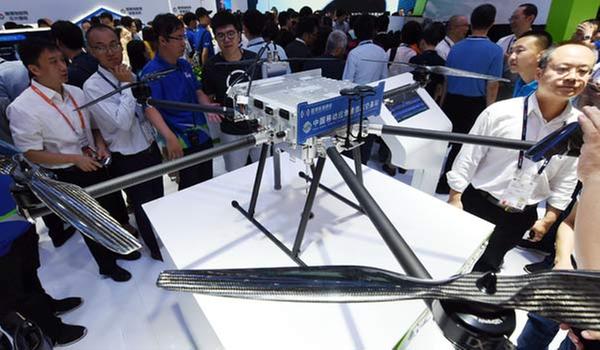 |
| China Mobile launches a UAV-assisted emergency communication high altitude base station during a recent mobile technology exhibition in Shanghai. [Photo by Long Wei/For China Daily] |
"The telecom industry will need to be deeply linked with other sectors when it comes to 5G," said Huang Yuhong, deputy head of the China Mobile Research Institute.
"That is a fundamental difference between 5G and 4G," Huang added.
Last year, China Mobile edged ahead of rivals to determine the "structure of 5G networks".
China United Network Communications Group Co Ltd plans to catch up fast after it fell behind China Mobile in the construction of 4G system.
This time, it is determined not to repeat that mistake.
Indeed, China Unicom's plans are underway to start technology tests in four to six cities in the next 18 months. Field tests will begin between 2018 and 2019.
"China has already made significant progress in the research and development of 5G, and more efforts will be made to ensure Chinese companies are at the forefront," Chen Zhaoxiong, vice-minister of the industry and information technology, said at a forum last month.
In June, the ministry unveiled a draft proposal that low-frequency bands-the 3,300 to 3,600 MHz spectrum and the 4,800 to 5,000 MHz spectrum-will be used for 5G networks in China.
Xiang Ligang, a telecom expert and chief executive officer of telecom industry website cctime.com, stressed that the "frequency band" was as important to telecom carriers as land was to the real estate sector.
"Specifying the initial frequency band for 5G tests will motivate enterprises to channel resources into it, and this will promote faster development," Xiang said.